

Wingsuits can make aircraft seatbelts awkward to reach, but awkward is not an excuse. A badly fitted restraint, excessively long extension or loose buckle can place everyone in the aircraft at risk.
You climb into the aircraft wearing a large wingsuit, sit down and discover that the seatbelt is somewhere underneath layers of material, your rig and half of your leg wing.
You try to reach it. You cannot quite get the buckle where it needs to go. Everyone else is already sitting down, the door is closing and you decide it will probably be fine.
Let’s be honest. Most of us have been on a load where someone has not worn a seatbelt. Some of us have probably been that person.
As wingsuiters, we can convince ourselves that our equipment makes connecting a restraint too difficult. Perhaps the hip ring is buried inside the suit. Perhaps the belt will not reach. Perhaps we are only going to be low enough for it to matter for a minute or two.
None of those things changes what happens if the aircraft suddenly stops.
An unrestrained person does not only risk injuring themselves. They can be thrown into the pilot, another skydiver or someone who did take the time to secure themselves.
That makes your seatbelt everybody else’s problem too.
Wearing a seatbelt and being restrained are not the same thing
The British Skydiving Operations Manual states that where skydiver restraints are fitted, they must be used during take-off and landing. The Jump Pilot Manual also makes it clear that the pilot must be satisfied that skydivers are correctly restrained when required. epend on the aircraft, its Flight Manual and the drop zone’s local procedures. Some smaller aircraft may operate differently because loose floor restraints can themselves create serious snag and hang-up hazards.
Whatever system is fitted, the purpose remains the same.
It is there to prevent you from travelling through the aircraft during a sudden deceleration.
That sounds obvious, but some of the restraint arrangements we accept would allow a wingsuiter to move several feet before the belt did anything useful.
Technically, the belt is connected.
Practically, the person is barely restrained.
A metre-long extension is not a solution
Seatbelt extensions are common on wingsuit loads. Often they are made from climbing slings because they are strong, readily available and easy to connect to a harness before boarding.
The problem is not necessarily the use of an extension.
The problem is its length.
I have two photographs that demonstrate this perfectly. In one, I am connected to the aircraft using a long sling but can still move halfway down the cabin. In another, the same extension allows me to reach the pilot’s seat.
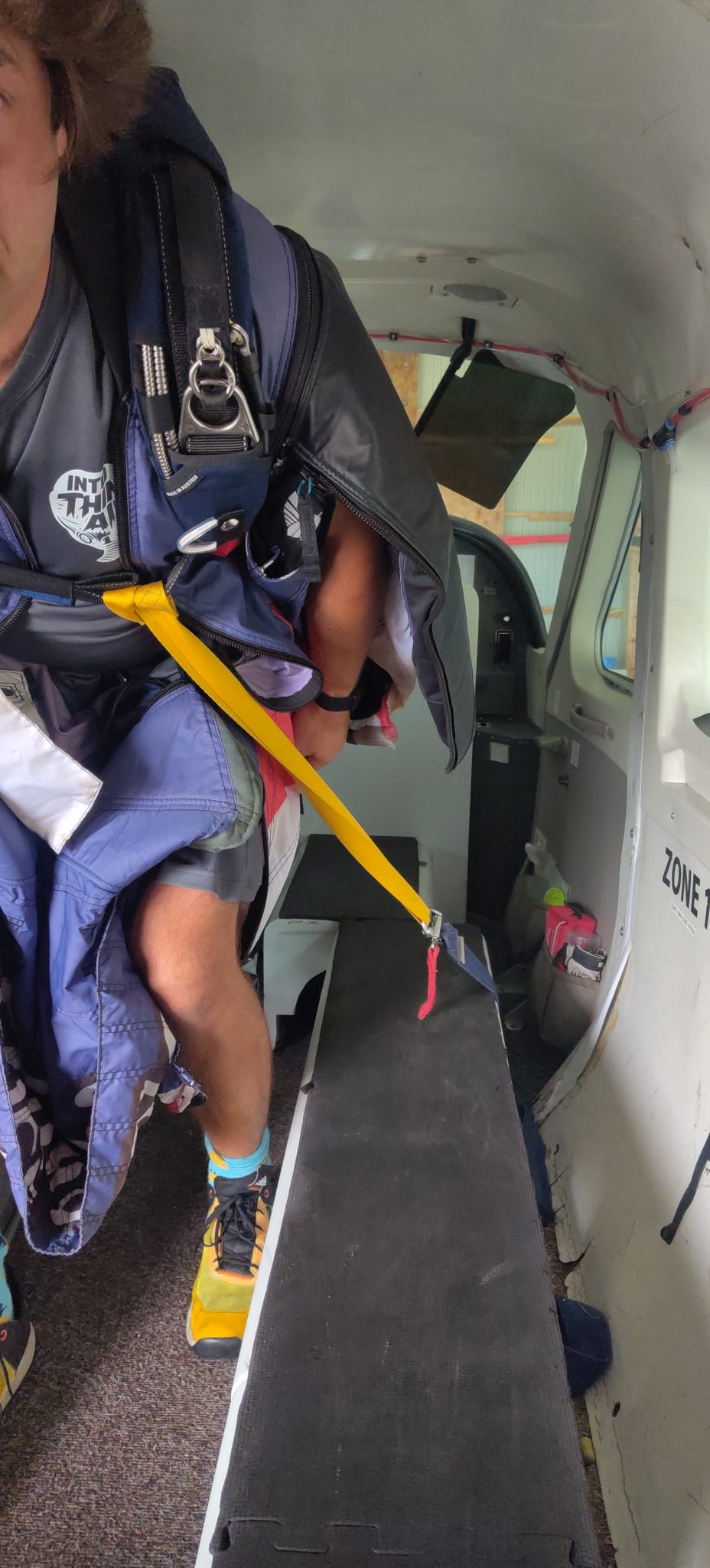
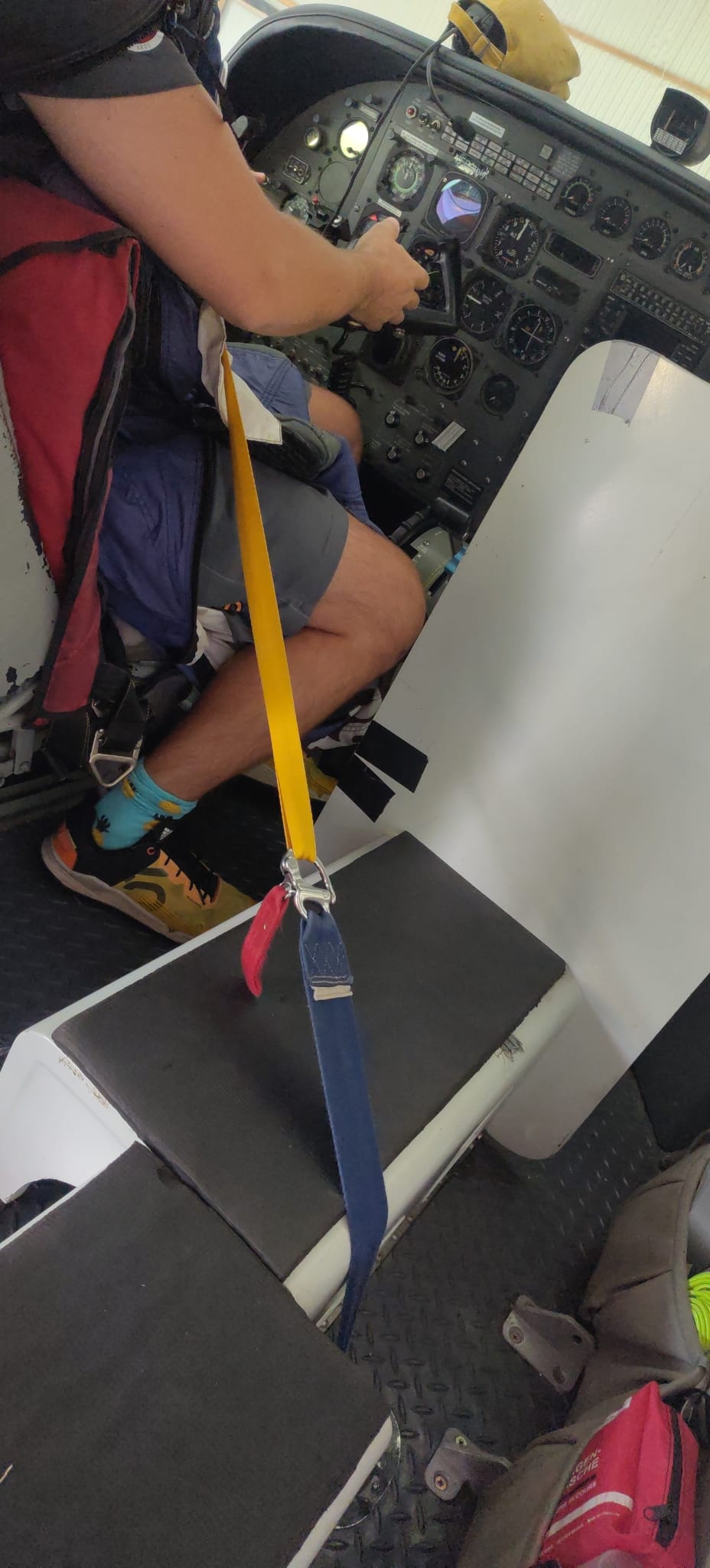
They are deliberately exaggerated photographs, but that is exactly why they work.
If your extension allows you to reach the pilot during normal movement, imagine where you could end up during a forced landing.
The extension may eventually stop you, but only after your body has built momentum. By that point, you could already have struck another jumper, damaged equipment or interfered with the pilot.
Testing of single-point skydiving restraints has shown that their effectiveness depends heavily on attachment position and the removal of slack. A tightly restrained jumper cannot build the same momentum as someone given room to move before the restraint loads. extension is to make the aircraft restraint accessible.
It is not to give you freedom to walk around the aircraft.
Start with the simplest attachment method
In many cases, you can connect the aircraft restraint directly to your harness.
For an articulated harness, the hip ring is often the most obvious accessible attachment point, depending on the restraint design and the procedure approved by the drop zone.
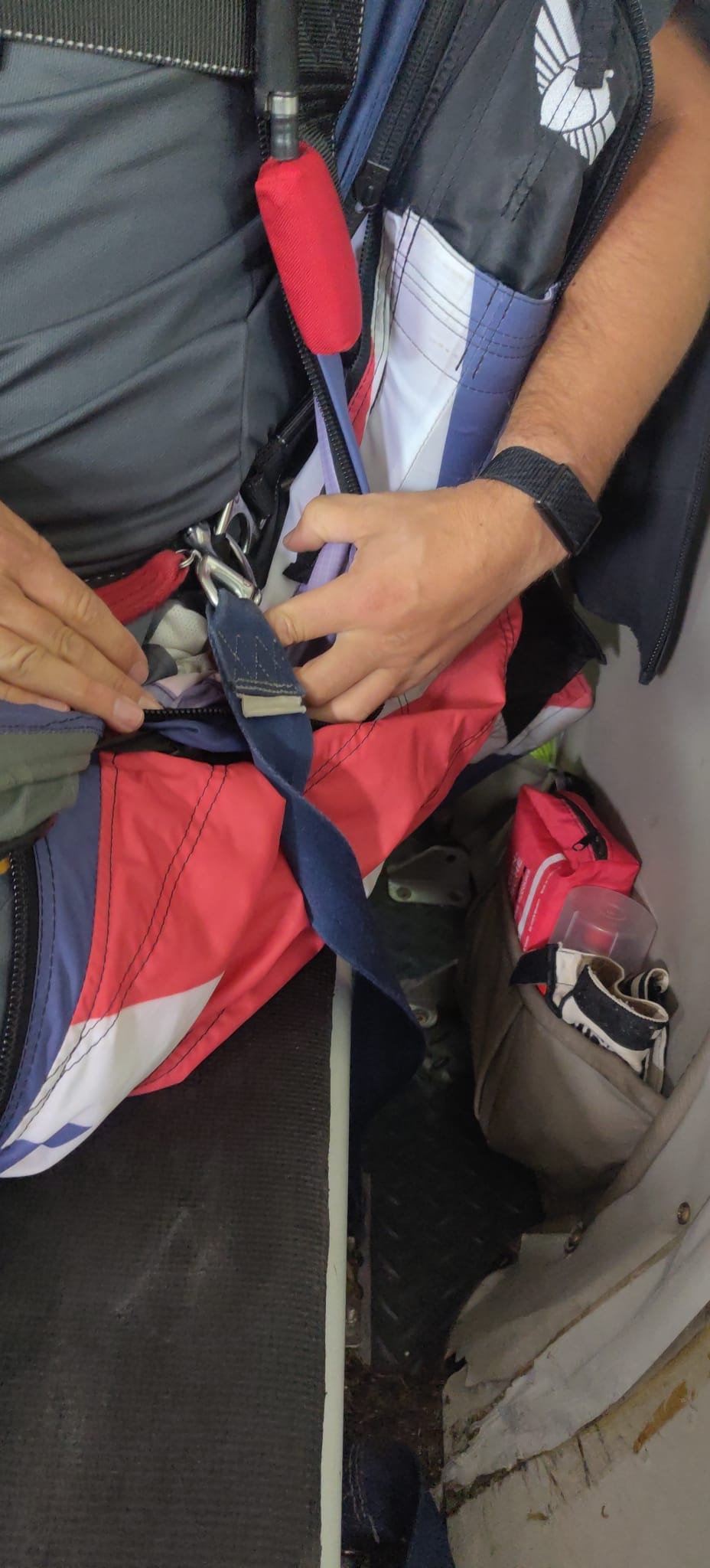
The wingsuit may make it look inaccessible, but that does not always mean it actually is.
You may only need to partially unzip the suit, move some material aside and expose the hip ring before sitting down. That takes a few extra seconds before boarding, but it makes connecting the restraint much easier once you are inside.
Prepare the access point on the ground rather than discovering the problem while everybody is waiting for the aircraft to move.
Whatever method is being used, check that:
- the restraint is attached to an approved part of the parachute harness;
- the connection is clear of your cutaway and reserve handles;
- it is not routed through loose wingsuit material;
- it cannot interfere with the operation of the three-ring system;
- the release remains visible and reachable;
- unnecessary slack has been removed.
Do not simply clip into the first piece of webbing or hardware you can reach.
A short sling can make access much easier
Where direct access to the harness is difficult, a short sling can provide a practical solution.
The important word is short.
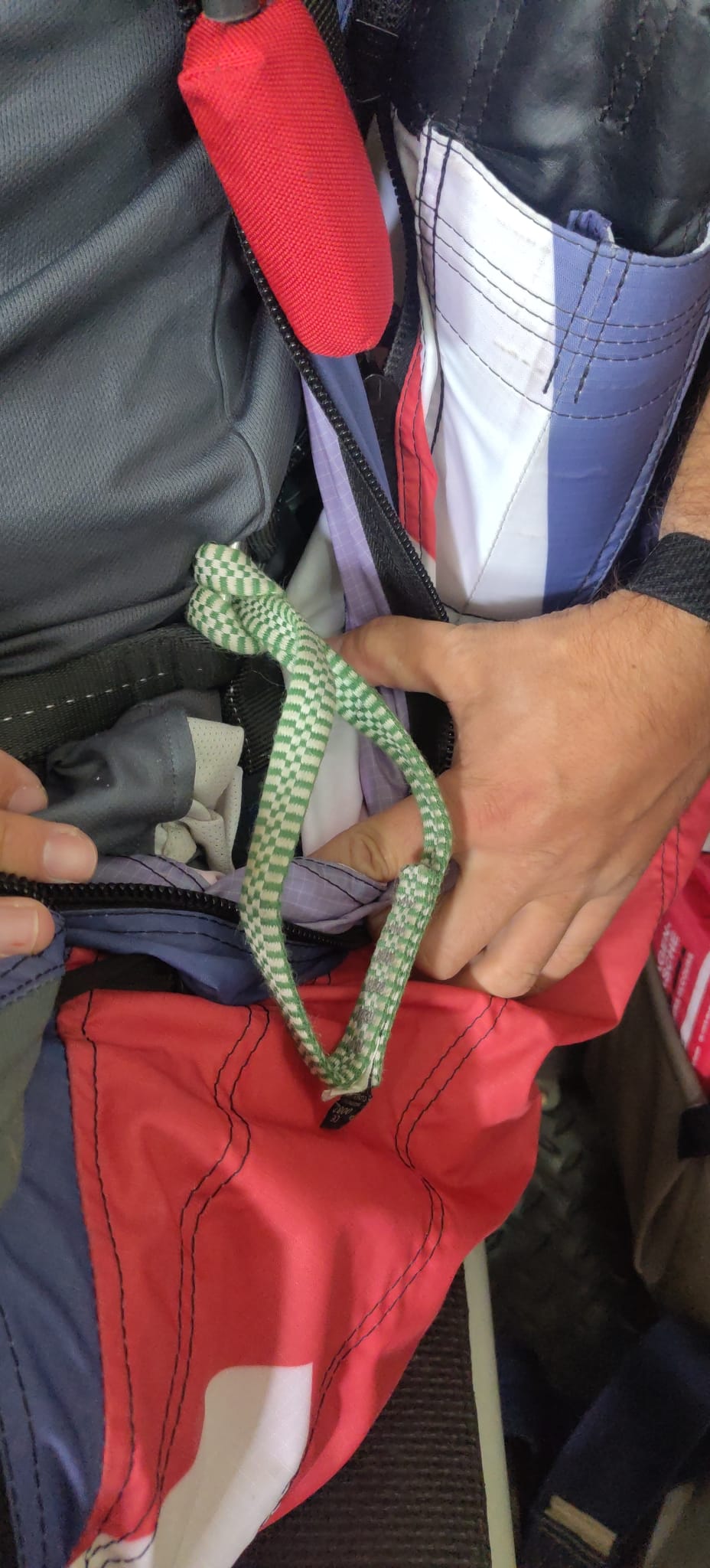
You can connect an appropriately selected sling to the approved harness attachment point before boarding. The accessible end can then sit within or just outside the wingsuit, allowing you to connect the aircraft restraint without having to search underneath the suit.
Because it remains inside the wingsuit during the jump, it does not necessarily need to be removed in the aircraft, provided it has been positioned and approved so that it cannot interfere with your handles, harness or deployment systems.
This should still be discussed with the drop zone, a suitably qualified rigger and, where necessary, the harness manufacturer. A climbing sling is not automatically an approved aircraft restraint simply because it has a high load rating.
Its purpose should be to provide access to the correct attachment point.
Not to add a metre of movement.
A very simple test is to connect yourself and see how far you can move.
- Can you stand up?
- Can you reach the next row?
- Can you get anywhere near the pilot?
If the answer is yes, the extension is probably too long to provide meaningful restraint.
Once released, the seatbelt becomes a snag hazard
Disconnecting your restraint does not mean you can simply throw it onto the floor.
Loose aircraft belts, open buckles and extended webbing can become significant snag hazards, particularly when people begin moving towards the door.
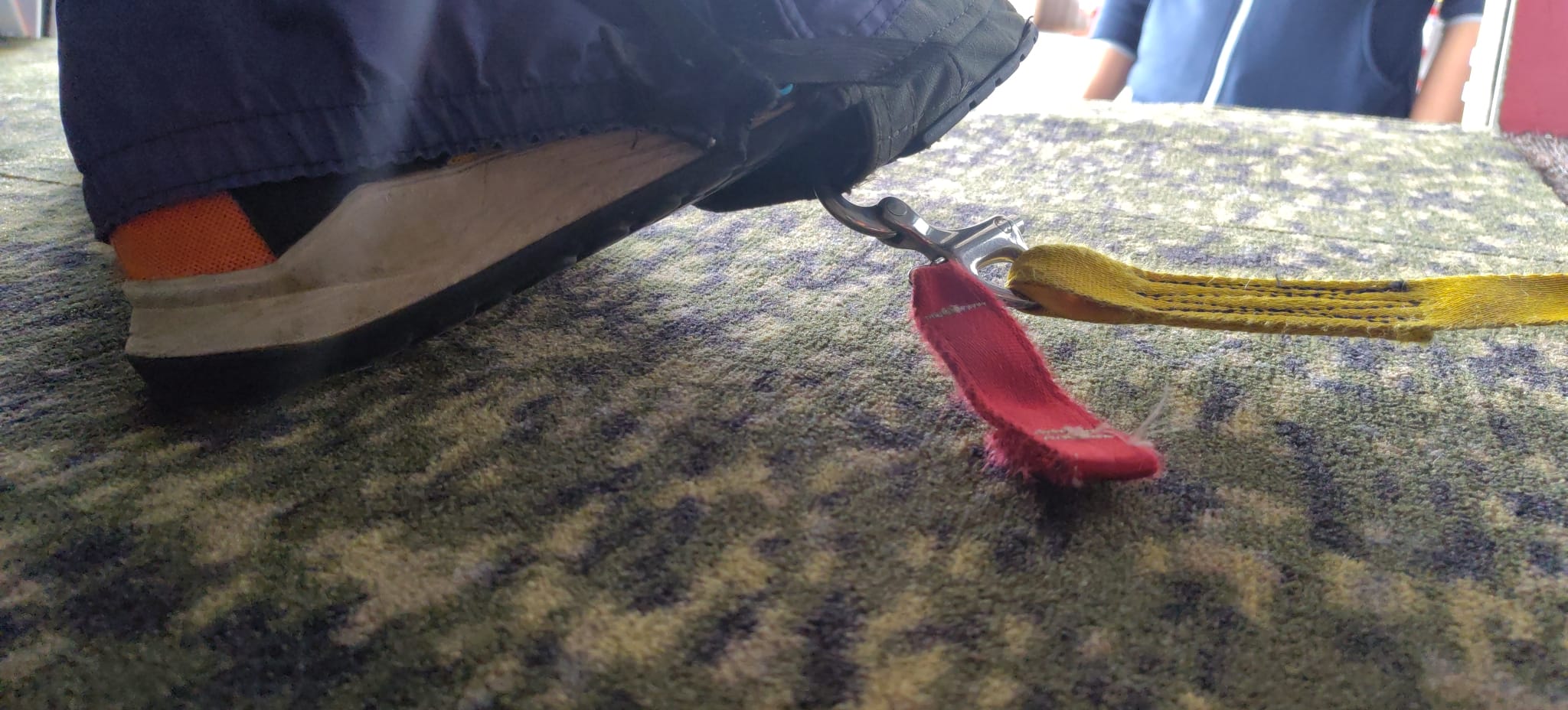
This matters on any skydiving load, but wingsuits give the belt far more material to catch.
The person nearest the front of the aircraft may be a relatively inexperienced flyer or a tandem student who is concentrating on their own exit. They may not notice that a buckle has been left open behind them.
Now imagine moving quickly towards the door and catching your leg wing, arm wing or suit fabric on that buckle.
It may not hold your entire body weight indefinitely, but that does not make the situation harmless. You could be pulled off balance, damage the suit, strike the aircraft or find yourself partially outside the door while still attached.
The British Skydiving Jump Pilot Manual specifically recognises the potential for floor restraints and fittings to snag equipment or cause hang-ups. ct:
- Close the buckle.
- Shorten or gather the webbing where possible.
- Place it carefully and flat against the floor.
- Check that it is not lying across anyone’s equipment or exit path.
It takes seconds.
Know exactly when you are allowed to disconnect
The altitude at which restraints are released is not uniform across every drop zone or aircraft.
Do not assume that the procedure from your home DZ applies everywhere else.
Listen to the aircraft briefing. If the release altitude or signal is not clear, ask before boarding.
Mixed loads also require more thought.
A tandem instructor may need to adjust or remove restraints at a different altitude from the wingsuit group. Consider what happens if a tandem begins moving around the aircraft at 2,000 feet while you remain connected until 1,000 feet.
If an emergency occurs between those altitudes, where will the tandem instructor and student end up?
Possibly on top of you, your wingsuit or your handles.
That does not mean tandems and wingsuiters cannot share an aircraft. It means the movement plan needs to be understood by the jumpmaster, the tandem instructors and everyone sitting nearby.
The briefing should cover more than when you personally disconnect.
It should cover what the whole cabin does afterwards.
A restraint has two jobs.
It must keep you in position during an impact, and it must allow you to release yourself afterwards.
That is why purpose-designed quick-release hardware matters.
An ordinary climbing carabiner may appear strong enough, but strength is not the only requirement. Imagine the aircraft has overturned and your body weight is loading the connection.
Can you still operate the gate?
Can you see it?
Can you reach it with either hand?
Could you release it while injured, disorientated or surrounded by other people?
I would not be comfortable relying on an ordinary carabiner as the primary means of releasing myself from an aircraft restraint.
Purpose-designed parachutist restraints are available with quick-ejector or quick-release fittings because emergency release under difficult conditions must be considered alongside restraint strength. raft using a restraint arrangement that cannot be released quickly and intuitively, raise it with the drop zone.
Do not quietly accept it because that is what everyone else does.
The wingsuit seatbelt check
Before every take-off, ask yourself:
- Am I actually restrained?
- Is the attachment method approved for this aircraft and harness?
- Have I removed unnecessary slack?
- Is the restraint clear of my handles and cutaway system?
- Can I reach and operate the release?
- Do I know the signal or altitude for disconnecting?
- Do I understand how tandems and other groups will move around me?
- Will I close the buckle and place the belt safely after releasing it?
If any of those answers are unclear, sort them out before the aircraft moves.
Awkward is not an excuse
A wingsuit makes aircraft restraint more complicated.
It can cover the hip rings, restrict movement and make something that is simple for another skydiver frustrating for you.
That does not make the restraint unnecessary.
It means you need to prepare properly.
Expose the correct attachment point before boarding. Use the shortest practical extension where one is needed. Remove slack. Keep the restraint clear of your emergency handles. Understand when it should be disconnected and place it safely afterwards.
Most importantly, look at whether the system would genuinely stop you moving.
Because if you can walk halfway down the aircraft while still connected, you are not really wearing a seatbelt.
You are simply attached to the aircraft by a long piece of webbing.
The checklist, the debrief template and the upsize framework - bundled as one guide, free for the network.
Other things worth reading.


Want this kind of thinking, monthly?
New episodes, field notes and event drops. One email a month. No marketing fluff, no hype.