

Should You Go to the Wingsuit Tunnel Before or After Your First Flight Course?
Should you visit the wingsuit tunnel before or after your First Flight Course? Three experienced coaches explain what tunnel training can teach, what it cannot replace and when it offers the greatest benefit.
Should you visit the wingsuit tunnel before or after your First Flight Course? Three experienced coaches explain what tunnel training can teach, what it cannot replace and when it offers the greatest benefit.
The wingsuit tunnel can teach you how to fly your body before you ever make a wingsuit skydive. But it cannot teach you the aircraft, the flight plan, the navigation or what happens when it is time to deploy. So, is it better to go before your First Flight Course, or wait until you have experienced the real thing?
There is a particular moment before your First Flight Course when the whole idea of wingsuiting suddenly feels very real.
You have the suit. You have the coach. You have probably watched far too many videos. Then your brain starts filling in all the bits the videos conveniently leave out.
Am I going to hit the tail?
What if I lose control as soon as I leave the aircraft?
How am I supposed to navigate back to the drop zone while wearing what feels like a straitjacket?
And when it is time to deploy, will I actually be able to reach the pilot chute without putting myself into a violent spin?
These are not ridiculous fears. They are the natural result of adding something unfamiliar to a skydive that already contains a lot of moving parts.
Which is why the wingsuit tunnel appears to offer such an obvious solution. Go there first, learn how the suit feels, develop some control and arrive at your FFC already knowing how to fly.
But is it really that simple?
To explore it properly, I spoke with three coaches who approach the question from different directions: Patrick Kramer, who coaches at the Inclined wingsuit tunnel in Slovenia; Becca Jordan, a SQRL wingsuit coach based in Moab; and Sam Laming, a Phoenix-Fly coach who predominantly works with wingsuiters in the sky.
What came out of that conversation was not an argument for one perfect route. It was a much more useful distinction:
The tunnel can prepare you to fly a wingsuit. It cannot, by itself, prepare you to make a wingsuit skydive.
What are first-time wingsuiters actually worried about?
The exit and the deployment came up immediately.
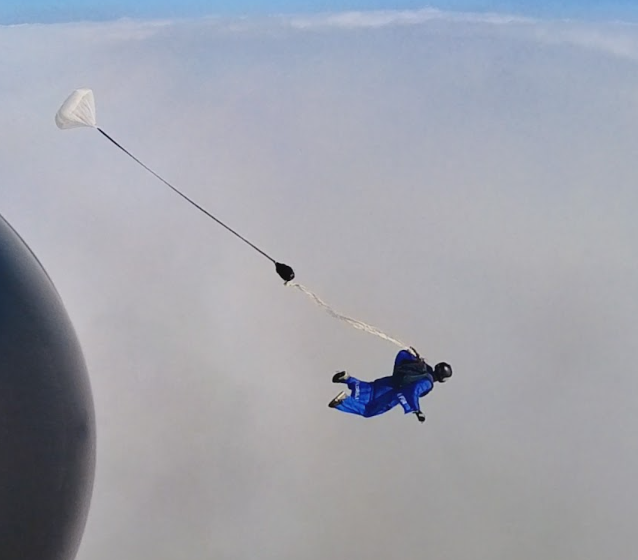
Becca described the classic fear of feeling trapped in the suit, unable to use your limbs properly. Sam saw the same uncertainty around deployment, while Patrick added everything that can happen afterwards: line twists, canopy problems and dealing with those situations while your movement is still restricted.
Interestingly, navigation was not normally the thing students worried about most.
That may be part of the problem.
Flying a wingsuit is exciting and unfamiliar, so it naturally takes most of the attention. But the first jump is not just a body-flight exercise. You need to know where you are going, where you should not be flying, where you intend to open and what you will do if the jump does not unfold as expected.
A good FFC therefore has to reduce the noise. Sam explained that his own courses have become simpler over time, not because the detail does not matter, but because a first-time student can only process so much. The objective is not to turn someone into a complete wingsuit pilot in one briefing. It is to give them what they need to make a safe, controlled first jump and then build from there.
That means the priorities stay fairly simple:
- exit the aircraft safely
- establish controlled flight
- follow the agreed flight plan
- maintain altitude and positional awareness
- make deliberate practice pulls
- deploy in the correct place and at the correct altitude
- be ready to deal with the canopy that follows
The tunnel can help with some of that. It cannot recreate all of it.
The strongest argument for going before your FFC is mental capacity
Your brain only has so much bandwidth.
If the suit feels completely alien, a huge amount of attention will go into simply holding a position and wondering whether you are stable. That leaves less capacity for checking altitude, looking where you are going, remembering the flight plan and preparing properly for deployment.
This is where pre-FFC tunnel time can make a real difference.
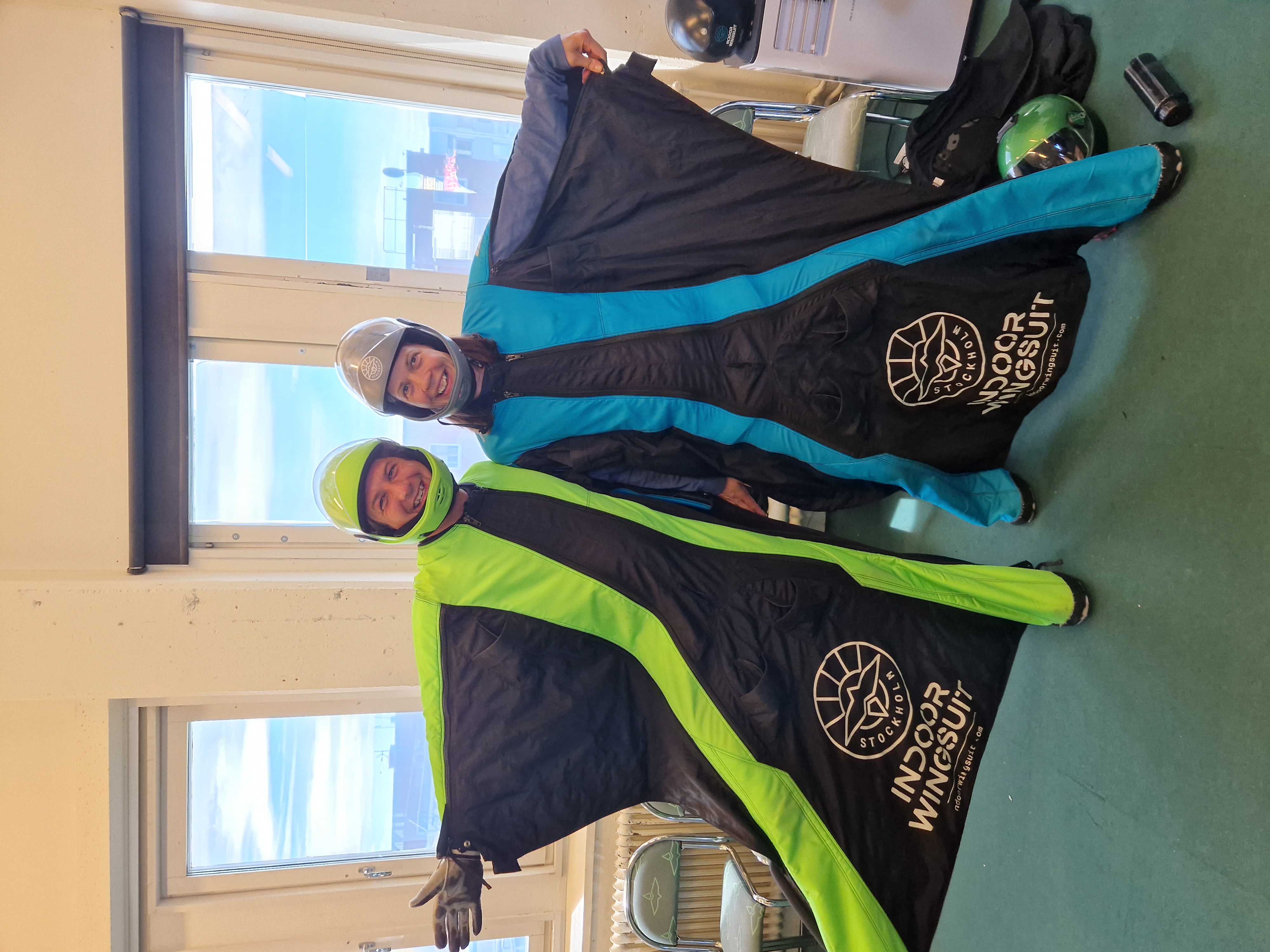
Patrick's argument was straightforward: if your body has already experienced the suit under inflation and you understand how to maintain a stable flying position, that is one less problem to solve on the jump. You can give more attention to the parts that are specific to skydiving.
The tunnel also gives you something the sky never does: time and repetition.
In the sky, every practice pull happens against a clock. Even when you are deploying high, the awareness of altitude can make new flyers rush. The movement becomes aggressive, the upper body rises, the legs drop and a simple action becomes far messier than it needs to be.
In the tunnel, you can slow the whole process down. You can learn to collapse the wings deliberately, keep the body controlled, reach for the pilot chute and repeat the movement until it stops feeling dramatic.
No, it is not a real deployment. There is no parachute leaving the container and no opening to manage afterwards. But becoming familiar with the movement can remove some of the panic surrounding it.
The difference is not always technical skill
Both outdoor coaches had seen the effect of tunnel experience in early wingsuit students.
Becca described one student who arrived with significant tunnel time and seemed to understand everything immediately. His exits were clean, his practice touches were slow and deliberate, and his awareness inside the suit was obvious. By the fourth jump, he was already transitioning in his slot and flying on his back.
Sam had seen something similar with a student who had completed far less tunnel time. Again, the biggest difference was not necessarily a collection of advanced manoeuvres. It was how calm and aware the student appeared.
That matters.
A calm student has time to look around. They can listen to the coach, recognise what the suit is doing and respond without turning every movement into a fight. The tunnel does not simply teach inputs; it can make the entire experience feel less hostile.
But we also need to be careful with examples like these.
Ten hours in the tunnel before an FFC is not a normal prerequisite. It is an enormous amount of training, and the fact that someone progresses exceptionally quickly after it does not mean everyone needs to follow the same route.
There is a big difference between something being beneficial and it becoming an unofficial entry fee to the sport.
The tunnel is an advantage, not a prerequisite
This was probably the most important point from the whole conversation.
When I asked Sam whether he would recommend the tunnel to someone approaching their FFC, his answer was essentially: if you have the money and access, absolutely. But if you do not, do not panic. Find a good coach, arrive current and take the progression seriously.
Becca agreed. The tunnel can be an excellent way to prepare, but it is not the only valid way to learn.
That distinction matters because access is not equal. Travelling to a wingsuit tunnel, paying for coaching, accommodation and several hours of flying is a serious investment. We should not create a culture in which someone believes they are unsafe or inadequately prepared simply because they cannot afford it.
People completed good First Flight Courses before wingsuit tunnels existed. They still do now.
The quality of the FFC, the student's general skydiving experience, their currency, equipment, attitude and the coaching they receive afterwards all matter enormously. Tunnel time can strengthen that foundation, but it does not replace it.
Tunnel time does not make skydiving experience disappear
There is another temptation we need to avoid: treating tunnel competence as a substitute for the experience requirements that exist before someone begins wingsuiting.
Becca made the point that she did not feel ready when she first reached the minimum number of jumps and waited until around 300. Sam was even clearer that putting someone with only 100 skydives into a wingsuit would make no sense, regardless of how much tunnel time they had completed.
That is because the jump-number requirement is not only there to prove you can control your body in freefall.
Those jumps are where you learn how aircraft operations work. They expose you to changing weather, imperfect spots, other canopies, unfamiliar drop zones, equipment issues, rushed loads and the countless small decisions that build genuine situational awareness.
The tunnel can dramatically accelerate one part of your development. It cannot give you the judgement that comes from repeatedly making real skydives.
So no, being brilliant in the tunnel should not allow someone to bypass the normal requirements for beginning wingsuiting.
Being able to fly a suit does not mean it is the right suit for your first jump
The most interesting disagreement in the conversation came from suit choice.
Patrick had recently been involved in an FFC with two students who had each completed three hours in the tunnel. They trained in a Havok and then made their first wingsuit jumps in the same model. Both performed well.
That is a useful example of what structured preparation can make possible. But Sam raised an equally important objection: what is actually gained by putting a first-time student into the larger suit?
The part of the jump that cannot be properly recreated in the tunnel is the deployment, and that is one of the areas where additional surface area and suit pressure can punish mistakes. A student may be perfectly capable of flying the suit until everything stops going to plan.
That is the real test of progression decisions—not whether something works when it goes well, but how quickly it can deteriorate when it does not.
Tunnel ability should not become an excuse to skip sensible equipment progression. If anything, good tunnel training should reinforce the opposite lesson: control comes first, and suit size follows later.
There is also a very strong case for going after your FFC
Doing the FFC first gives the tunnel context.
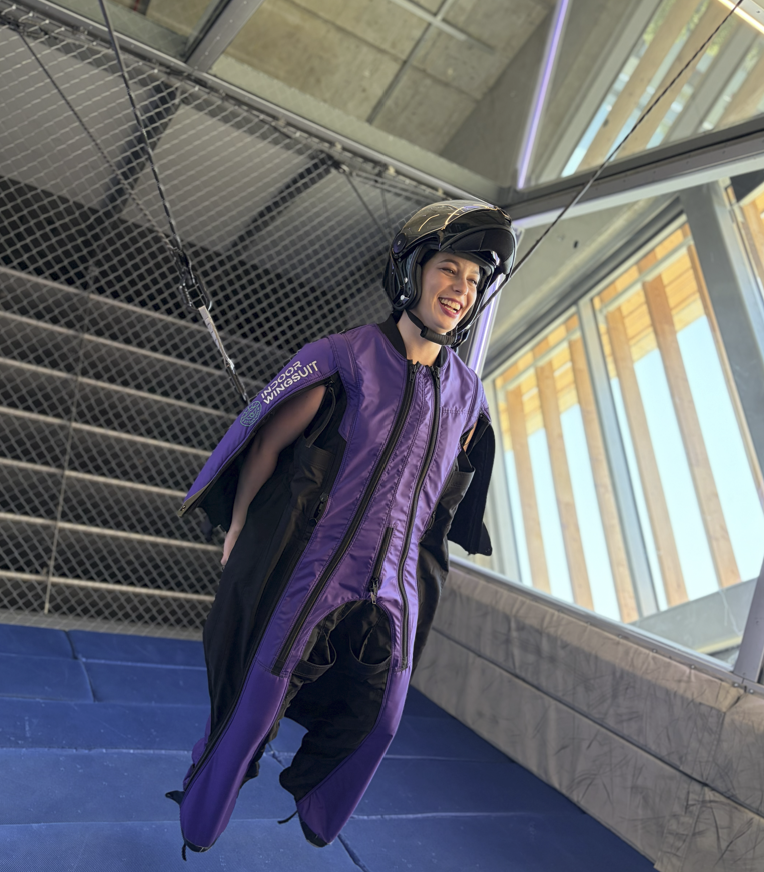
Once you have made a real wingsuit jump, you understand the parts that are difficult to explain on the ground. You know how the exit feels, how quickly the flight passes, how the suit behaves when you prepare to deploy and how much attention the overall skydive demands.
You also arrive at the tunnel with actual problems to solve.
Perhaps your heading control was poor. Perhaps you were flying with tension through your arms. Perhaps every input was much larger than it needed to be, or your practice pulls unsettled the whole suit. Instead of going into the tunnel simply to learn 'wingsuiting', you can begin connecting the coaching to something you have already experienced.
That was broadly my route.
I completed my FFC without any tunnel time and went to the tunnel after roughly 30 wingsuit jumps. At the time, the UK scene was fairly quiet and I was making a lot of solo jumps. If I am honest, the thing I had wanted to do for so long was beginning to lose some of its excitement because I could not see a clear route forward.
Two hours in the tunnel changed that completely.
It gave me direction, accelerated the basics and opened a form of progression I had not been able to find through solos. Not long afterwards, I entered my first national acrobatic competition with fewer than 100 wingsuit jumps. The point is not the result. It is how much focused repetition changed what I could do with the jumps I already had.
Would I have benefited from going before my FFC? Almost certainly.
Would those two hours have meant as much without any experience of the sky? I genuinely do not know.
That is why I do not think the answer can simply be 'before'.
Do not wait until bad habits feel normal
While there may not be one perfect moment, there is a strong argument for going relatively early.
Sam first visited the tunnel with well over a thousand wingsuit jumps. He could fly his slot, backfly and perform acrobatic manoeuvres, but the tunnel video exposed small, jerky movements through his arms that had become part of the way he flew. He already knew they were there, but not to the extent the tunnel revealed.
Patrick sees the same thing regularly. Experienced wingsuiters arrive with thousands of jumps and habits that are now deeply embedded in their muscle memory. The corrections may be tiny—a slight change in head position, tension through one part of the body or an inefficient input—but unlearning them can take far longer than learning the movement cleanly in the first place.
The earlier you build good movement, the less time you spend trying to remove the bad version later.
That does not mean you need to rush from your FFC directly to Slovenia or Sweden. It does mean that waiting until you feel 'experienced enough' to deserve the tunnel misunderstands what it is for.
You do not need to be good before you go. You go because you want to learn properly.
The real progression should continue after the FFC
One of the more valuable turns in the conversation was that the problem may be bigger than tunnel timing.
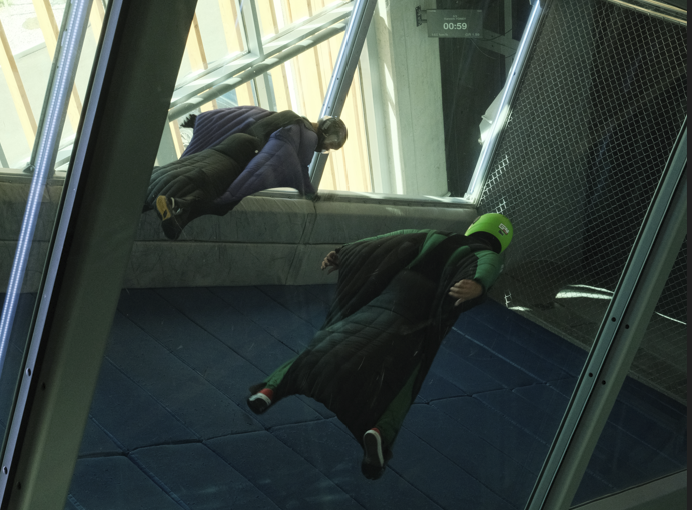
Too often, the FFC becomes the finish line. The student completes the jump, everyone high-fives, and then they are left to work out what wingsuit progression is supposed to look like next.
That is where solos begin to pile up. It is where poor habits go unchallenged and where a bigger suit starts to look like the obvious way to create a sense of progress.
Becca makes a point of telling students that being able to fly a small suit well alongside larger suits is something to be proud of. Sam argued that before moving on, flyers should have explored backflying, barrel rolls, corkscrews, flat turns and more dynamic movement. Patrick described the tunnel's own progression: ropes, leash, controlled belly flying, backflying, transitions and dynamic movement before a larger suit is even considered.
Different environments will use different structures, but the principle is the same.
Your FFC should open the door to progression, not leave you standing on the other side without a map.
So, should you go before or after?
If you have access to good tunnel coaching before your FFC, there is a strong case for using it.
Learning how the suit feels, developing basic control and practising deliberate movements can reduce the mental load on your first jump. It can make you calmer, more aware and more receptive to your outdoor coach.
But it is not mandatory. It does not replace the FFC, it does not replace skydiving experience and it does not automatically justify a larger suit or faster progression.
If going before is not realistic, complete a thorough FFC with a good coach. Then consider visiting the tunnel early enough that it can refine your foundations before inefficient habits become normal.
And if you already have hundreds or thousands of wingsuit jumps, it is not too late. You may simply get a more honest view of your flying than you were expecting.
The better question is therefore not only before or after?
It is: how can I use both environments to become a more complete wingsuit pilot?
The sky teaches you how to make the skydive. The tunnel gives you time to examine how you fly. Used together, with good coaching and sensible progression, each makes the other more valuable.
That is the answer. Not tunnel instead of FFC. Not FFC instead of tunnel.
The right training, in the right environment, for the skill you are actually trying to build.
Inclined’s First Flight Course combines structured tunnel training with outdoor coaching, helping you build familiarity with the suit before taking those skills into the sky.
Other things worth reading.


Want this kind of thinking, monthly?
New episodes, field notes and event drops. One email a month. No marketing fluff, no hype.