
Barometric vs GPS Altitude: Why Your Altimeter Might Be Lying to You
Your'e at a world meet, the green light is on, your altimeter says you're low, and someone's asking the pilot to go round again. The judges' GPS data might tell a very different story. Here's why barometric and GPS altitude don't always agree, and why it matters for both wingsuit performance and acro.
Your'e at a world meet, the green light is on, your altimeter says you're low, and someone's asking the pilot to go round again. The judges' GPS data might tell a very different story. Here's why barometric and GPS altitude don't always agree, and why it matters for both wingsuit performance and acro.
You're sitting in the aircraft at the FAI World Wingsuit Flying Championships. The green light comes on. You glance at your wrist: 11,400 feet. Minimum exit is 12,000.
Do you go?
I've watched this play out more times than I can count. Teams refuse to exit, the aircraft goes round for another pass, or they land and head straight to the judges to protest that they were dropped low for a rejump.
And very often, the PLD shows they were exactly where they should have been.
Nobody's equipment was broken. On a hot day, a correctly zeroed barometric altimeter will read lower than your true geometric altitude, sometimes by several hundred feet at exit height.
The judges don't use your altimeter. They use the PLD.
Your altimeter doesn't actually measure altitude
Well, not directly anyway.
Most skydiving altimeters, whether it's a traditional analogue alti or something like an L&B ARES II, measure atmospheric pressure and use that to calculate your altitude.
As you climb, pressure decreases. Your altimeter recognises that change and converts it into a reading in feet or metres, using a standard model of how the atmosphere is supposed to behave.
It's a system that works extremely well for skydiving, but the real atmosphere rarely matches the model. Pressure changes with weather systems, and the relationship between pressure and height changes with temperature.
This is why we zero our altimeters on the ground. If you're using an ARES II or VISO II+, the instrument normally does this automatically between jumps.
But here's the important bit. Just because your altimeter reads zero on the ground doesn't mean it will agree with GPS altitude at 12,000 feet. Both can be working exactly as intended and still show different numbers.
GPS altitude measures something different
Rather than using pressure, GPS calculates your position from satellite signals, horizontally and vertically. It doesn't care what the air is doing, although it has its own limitations, such as signal quality.
In wingsuit competition, the FAI uses geometric altitude: height above ground level measured by GNSS, optical methods or radar. It's recorded by a Position Logging Device (PLD).
Under the 2026 rules, the PLD must record at least five position measurements per second, with a position accuracy of better than 10 metres.
That's tens of feet, not hundreds. So if your altimeter and the PLD disagree by 500 feet, the GPS isn't the problem.
There's one more small detail. Geometric altitude is measured from the DZ elevation, set by the Meet Director and published in Bulletin #2. Your altimeter zeroed itself wherever you happened to be sitting. Usually that difference is small, but it's another reason the numbers can drift apart.
Your wrist-mounted altimeter might disagree with the PLD, but it isn't the instrument being used to judge the competition.
Why a hot day makes your altimeter read low
I'm currently at Skydive Elsinore for the 2026 FAI World Wingsuit Flying Championships. We've had temperatures in the mid-30s this week, and Tropical Storm Rachel is now heading towards Southern California.
That makes it a useful example.
Warm air expands. On a hot day, each pressure level sits higher above the ground than the standard model expects. So when you climb to a given geometric height, the pressure around you is higher than your altimeter thinks it should be, and it concludes you're lower than you really are.
The rule of thumb is roughly 4 feet of error for every 1,000 feet above your zero point, for every degree Celsius the air is warmer than standard.
Standard temperature at Elsinore's elevation is around 12°C. A mid-30s day, with the difference usually a bit smaller higher up, puts us something like 10–20°C above standard through the jump altitudes. That works out roughly as:

This isn't an equipment fault. It's simply what the atmosphere does.
In colder-than-standard conditions, the opposite happens: your altimeter reads higher than your true height.
What about pressure changes from weather systems? As a rough guide, 1 hPa is around 27–30 feet near sea level. But modern altimeters re-zero themselves on the ground, so that part is largely taken care of. The temperature effect is the one you can't zero away.
It's also why the gap you saw yesterday may not be the gap you see tomorrow. With Rachel's remnants expected to bring much cooler air this weekend, the difference between your alti and the PLD will change over the course of the same competition.
Before you ask for a go-around
So back to that green light.
The aircraft's exit signal tells you you're cleared to exit under the competition's jump-run procedures. It isn't telling you that you're at an exact barometric altitude.
On a hot day, the aircraft can be sitting at 12,000 feet geometric while your wrist shows something like 11,300. That's when teams start asking for another pass.
Here's the thing: the rules already protect you if the exit genuinely is low, and they do it using the PLD, not your altimeter.
- Acro: if the PLD registers an exit below 12,000 feet, the team can choose to accept the score. Otherwise, a rejump is granted automatically.
- Performance: the valid exit range is 10,500–11,000 feet, measured by the PLD. A low exit works the same way: accept the score or take the rejump.
- Refusing to exit: in performance, you have to report to the Meet Director as soon as you land. They review the official PLD data and the Flight Director's video. If your reason isn't accepted, you're scored as having made the jump, with the maximum penalty.
- Extra passes: these are at the Meet Director's discretion, not something you're entitled to.
- Your wrist alti won't win that argument.
That doesn't mean you should exit if something genuinely looks wrong. The decision to exit always rests with you, and safety comes first. Just know that a reading a few hundred feet low on a hot day is what the atmosphere does, not proof you've been short-changed.
Performance: the scoring window doesn't move
For wingsuit performance, the competition window is straightforward. Under the 2026 rules, it starts at 2,500 metres (8,202 feet) and finishes at 1,500 metres (4,921 feet) geometric altitude.
Within that window, you're scored on three separate tasks: time, distance and speed. The PLD decides exactly when you cross the upper and lower boundaries.
Now imagine you're flying a speed round on a hot day.
You glance at your altimeter and see 7,800 feet. You know the window starts at about 8,200 feet, so you think you're already in it and committed to your fastest configuration. In reality the PLD has you at 8,200 feet, crossing into the window right now, and you transitioned early.
On a cold day it goes the other way: your alti reads higher than the truth, and you can be in the window before you think you are.
This doesn't mean a few hundred feet will ruin your flight. Experienced competitors build their flights around a range of cues and review their actual data afterwards.
But assuming your barometric altitude matches the judging altitude could affect how well you use the window.
It's also worth knowing that the Meet Director can lower the exit altitude to no lower than 10,000 feet for weather or air traffic control reasons. The competition window itself stays at 2,500–1,500 metres.
Acro: the window works differently, and timing becomes critical
This is where I think things get particularly interesting.
In acro, the window isn't two fixed altitudes. Under the 2026 rules, teams exit between 12,000 and 12,500 feet geometric altitude.
The upper boundary of the window is set when the Designated Team Member (DTM), who wears the PLD, reaches a vertical speed of 10 metres per second after exit. The lower boundary is 7,500 vertical feet below that.
The window closes when the DTM's PLD first crosses that lower boundary.
There's one exception: if the exit altitude is formally lowered to 11,500 feet AGL or less, the window shrinks to 5,000 vertical feet.
So the window is a fixed vertical distance, but neither end lines up with a nice round number on your wrist.
Here's what that can look like on a hot day:
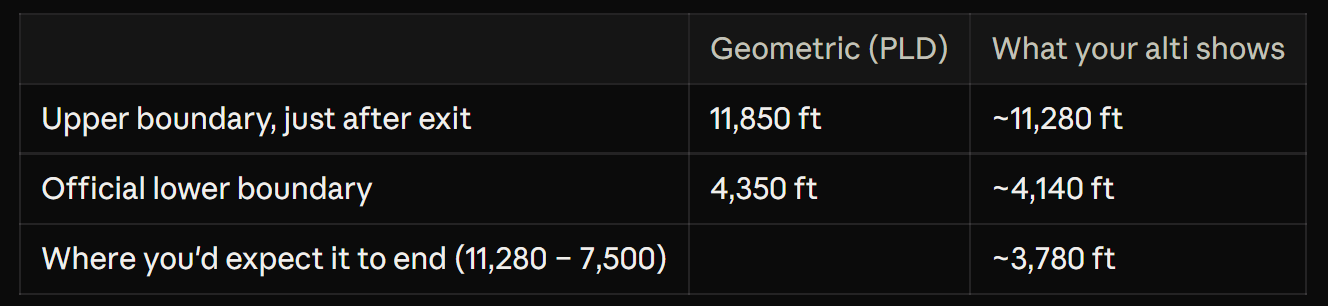
That 7,500 feet is geometric. On a hot day your alti only counts around 7,150 feet of it.
So if your team works out the end of the window by subtracting 7,500 feet from what your wrist showed after exit, the judges cut you off roughly 350–400 feet earlier than you expected. At around 100 feet per second, that's three to four seconds.
It can catch you out the other way too. If your audible is set to 4,500 feet as your "end of routine" cue, on a hot day it goes off at roughly 4,700 feet geometric, well before the window actually closes. That's three or four seconds of working time left on the table.
Illustrative example only. The actual difference depends on conditions, calibration and where the window starts.
Why it matters more than you might think for a free round
Anyone who's competed in acro knows how much work goes into a free routine.
You're trying to build something that flows, with clean transitions, controlled manoeuvres and good camerawork. You want it to look deliberate rather than a collection of tricks thrown together.
And the judges are looking at how you use your time. Working time management is one of the Dive Plan criteria, and using the working time as fully as possible is listed under Presentation.
Finishing with several seconds to spare isn't satisfying. But being mid-way through your final transition, or setting up your last grip, when the window closes is potentially worse.
Three or four seconds can be significant in an acro routine.
What about compulsory rounds?
It's still relevant, just in a slightly different way.
In compulsories, you're repeating the drawn sequences and being scored on style and the number of scoring grips within working time. With the wrong altitude reference, you might stop early or keep chasing grips after the window has closed.
With a free routine, it's often more noticeable because you're timing the whole sequence and its finish. It's not just how many manoeuvres you complete, but how the routine comes together in the time available.
What should you actually do differently?
I don't think this needs to become another complicated part of competition prep.
Keep using your normal altimeter and audible, and make sure they're working and set up properly before every jump. Under the rules you have to wear a working audible on every competition jump anyway. It's safety equipment first.
But if you're competing, a few things are worth doing:
- Know the official window. Understand the geometric boundaries for performance, and how the PLD sets the window for acro.
- Check the conditions. Hot day, your alti reads low. Cold day, it reads high. The bigger the gap from standard, the bigger the difference.
- Review your PLD data. Compare your altitude cues and working time against the official window rather than assuming they match.
- Acro teams, rehearse your timing. Understand how your fall rate and the PLD-defined window shape your real working time, especially if you want to finish a free routine at a specific point.
- Think before you call a go-around. If the exit is genuinely low, the PLD will show it and the rules will look after you.
- Don't treat your audible as a judging reference. Any extra competition cues must never compromise safe deployment.
It's not about which instrument is more accurate
It's tempting to say GPS is more accurate than barometric altitude, but that's not quite the right way to look at it.
A correctly calibrated barometric altimeter is consistent and extremely useful for altitude awareness. GPS has its own sources of error.
The difference is that geometric altitude is the reference the FAI has chosen for wingsuit competition. It doesn't depend on the temperature or pressure on the day, which matters when you're comparing flights fairly across competitors and changing conditions.
So next time someone says their altimeter disagrees with the judges' data, or asks the pilot to go round again, remember that both instruments might be doing exactly what they're supposed to.
Your altimeter tells you your indicated altitude. The PLD determines the official competition window. Understanding the difference could help you make much better use of the altitude you've got.
The checklist, the debrief template and the upsize framework - bundled as one guide, free for the network.
Other things worth reading.


Want this kind of thinking, monthly?
New episodes, field notes and event drops. One email a month. No marketing fluff, no hype.