
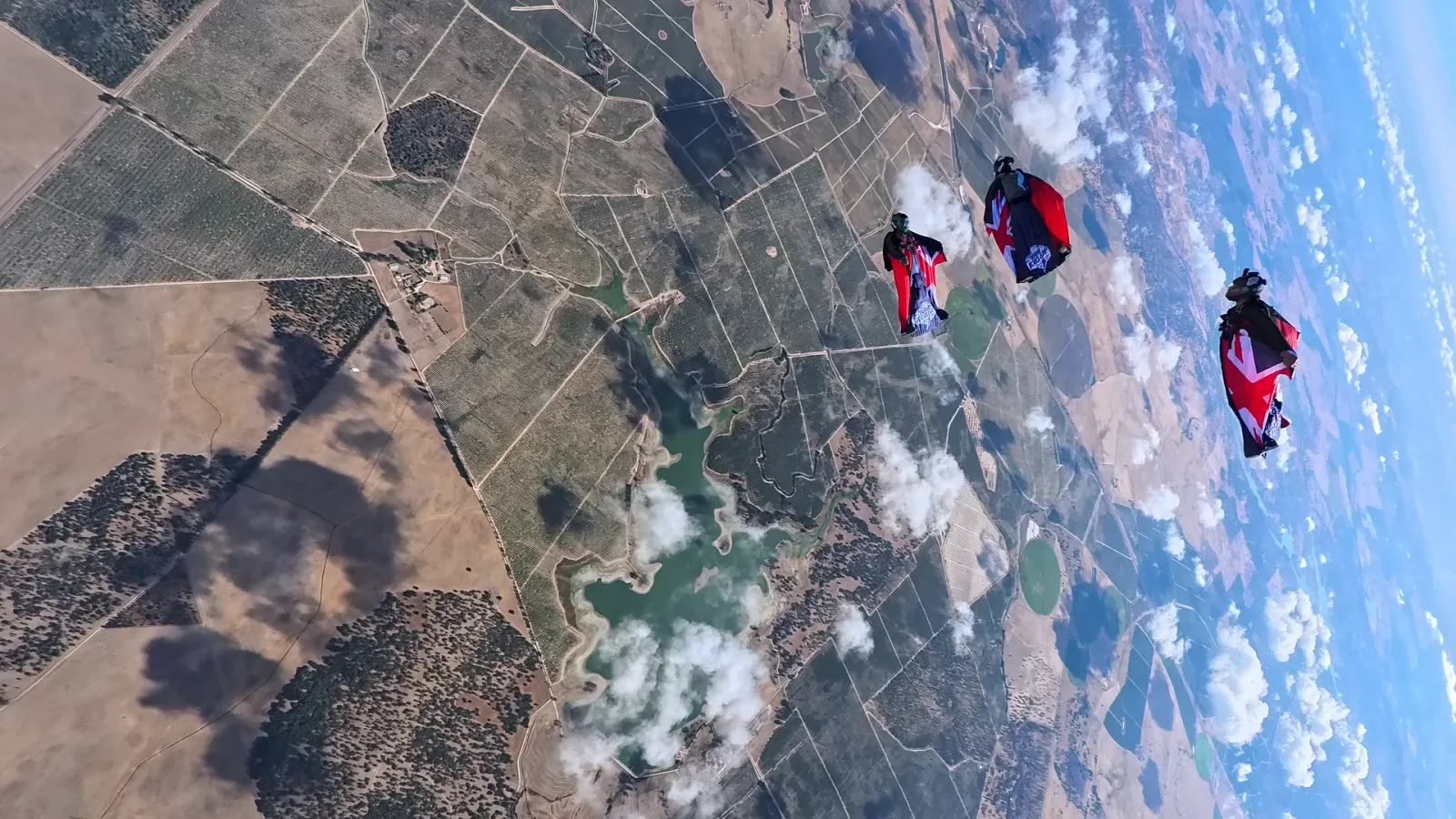
Running a Wingsuit Competition
Everything a Meet Director, DZO or competitor needs to put on a wingsuit competition: the two events, the people, the spaces, the aircraft and the day itself, built on the FAI rules, with downloadable template rules that open the door to Rookie and Intermediate competitors.
Everything a Meet Director, DZO or competitor needs to put on a wingsuit competition: the two events, the people, the spaces, the aircraft and the day itself, built on the FAI rules, with downloadable template rules that open the door to Rookie and Intermediate competitors.
Who this is for
This guide is for the three people who make a wingsuit competition happen: the Meet Director who runs the flying, the DZO who hosts it, and the competitor who wants to know what is being asked of them. It covers both events, the people, the spaces, the aircraft and the day itself.
It follows the FAI ISC Competition Rules for Wingsuit Flying, 2026 Edition (Ver. 2026.1, effective 1 March 2026), with rule numbers in brackets so every claim can be checked. Three things to hold onto throughout:
- The wingsuit rules sit under FAI Sporting Code Section 5, which covers protests, safety panels, video standards and general meet conduct. This guide points to SC5 where the rules do.
- National and local competitions usually run on national association rules, which may differ. The FAI rules are the reference model, and the template rules at the foot of this guide are built to adapt.
- Air law always overrides sport rules.
The two events at a glance
A wingsuit competition has two events that cannot run at the same time: Performance, one flyer against the clock and tape, and Acrobatic, a team of three judged on video.
| Performance | Acrobatic | |
|---|---|---|
| Who flies | One competitor per lane | Two performers and a videographer (2.3) |
| What is measured | Time, distance and speed through a height window (5.3) | Style, grips, dive plan and camerawork, judged from the team's video (7.2) |
| Programme | 3 rounds of 3 tasks, 9 flights (5.4.1) | 7 rounds, F-C-C-F-C-C-F: 4 compulsory, 3 free (6.2) |
| Minimum valid event | One valid task (5.4.4) | One round (6.2.1) |
| Exit altitude | 10,500 to 11,000 ft (5.4.5, 5.4.6) | 12,000 to 12,500 ft (6.3.1) |
| Competition window | 2,500 m down to 1,500 m above ground (2.2) | 7,500 ft from where the PLD wearer reaches 10 m/s (6.3.3) |
| Lanes | 600 m wide, one ground reference point each (2.2) | None in the rules |
| Judged from | Position logging device data, at least 2 judges (7.1.2) | Video, panel of 5 (7.2.4.2) |
Changing between events costs time: 30 minutes from Performance to Acrobatic and 60 minutes the other way (4.2.1.2). An FAI competition may not exceed 6 competition days (8.2.1), with a training day of two jumps per competitor or team before it (7.3.1).
People and roles
The Meet Director runs the flying and the Chief Judge runs the judging; both stay responsible even when they delegate (4.1.1).
| Role | What they own |
|---|---|
| Meet Director | Landing area and jump run, first exit point, exits per pass and spacing, reference point assignment and rotation, exit order, deployment heights, extra passes, refusals, lowering exit altitude, DZ elevation, stopping for weather (5.5, 5.6.1, 5.7.1, 7.4.3) |
| Chief Judge | Choosing ground reference points, equipment inspection, weigh-in, task and sequence draws, validating results, rejumps, consent to lowered exits (2.2, 3.2.2, 5.4.7, 5.4.8, 5.8.7, 6.6.4) |
| Judges | At least 2 per Performance jump, a panel of 5 for Acrobatic; they fit, switch and collect PLDs (7.1.2, 7.2.4.2, 3.2.6 to 3.2.8) |
| Technical Scoring Director | Scoring system set-up, PLD data import, archiving; may not also compete, judge or direct (4.1.2) |
| Flight Director | On every Performance load: points out reference points, runs the exit timer, checks spacing, videos jump run and exits. Never tells a competitor to exit (4.1.3) |
| Chief Pilot | Sets any exit limits for safety and gives the clear-to-exit signal (5.5.7, 5.6.1) |
| Descent observer | Watches every descent and opening (7.4.2) |
Three more roles are worth naming even at a small meet, because the rules assume the work gets done: a manifest lead who builds loads from the exit order and keeps a task on the same or consecutive loads (5.7.3), a PLD runner who carries devices between the landing area, the judges and the charging station, and a ground-to-air radio contact who passes holds to the pilot.
Before the event: is the dropzone suitable?
The dropzone has to hold a pass of lanes several kilometres long in whatever direction the wind dictates, and that is settled months ahead, not on the day.
- Space under the lanes. At the 2026 World Championships the best distance through the window alone was 5,040 m. Add the ground covered between exit and the window and a lane runs roughly 6 to 7 km. Each lane is 600 m wide and sits beside the next, so four competitors per pass need a block 2.4 km wide.
- Every wind direction. The jump run should be perpendicular to the wind line and upwind of the landing area (5.5.1). Plan the lane block for each likely wind direction and note which directions cannot be flown.
- Airspace. Exits run to 11,000 ft for Performance and 12,500 ft for Acrobatic, kilometres from the airfield. Agree the working area, altitudes and radio procedure with air traffic control in writing.
- Off-field landings. Competitors deploy at the end of long flights, often away from the airfield. Identify safe landing areas along each lane, the hazards, and how people are recovered.
- Aircraft. The same type must serve the training day and the competition (7.3.1.1). Check it reaches 12,500 ft with a full load at a turnaround that fits the programme.
Ground reference points. The Chief Judge chooses them; coordinates and a marked aerial photograph no more than 30 days old go in Bulletin #2 (2.2). Pick features a flyer can find from 10,000 ft at 300 km/h: a road junction, a building, a lake edge. One point per lane, on the lane's centre line, 600 m from the next, and a set for each wind direction.
Spaces and the chain of custody
In Performance each competitor wears a PLD supplied by the organiser and fitted by a judge, and from that moment the device and whatever it is mounted on stay in the judges' custody for the whole competition (5.8.6, 5.8.6.1). In practice the PLD goes on the helmet, so the judges hold every competitor's helmet between jumps. Most of the rooms below exist to protect that chain.
| Space | What it needs |
|---|---|
| Helmet and PLD custody room | Lockable, judges only, numbered racks, a hand-out hatch, close to boarding |
| Charging and download station | Power for every device plus spares, a download computer, sky view for lock checks |
| PLD return point at the landing area | A marked table and a vehicle for off-field landings; a lost PLD is a zero (3.2.11) |
| Performance scoring room | Quiet, backup power, reliable internet, two screens per judge |
| Acrobatic judging room | Darkened, one big screen, five scoring positions, no competitor access |
| Video dubbing station | On the route in from landing, so no team can pass without handing in footage (6.8.1) |
| Inspection and weigh-in | 3 m by 3 m of clean floor for the suit tape (Addendum D), calibrated scales |
| Briefing area, results board, Meet Director's desk | Room for everyone, one official results location, sight of the sky and the radio |
Keep judges' rooms out of earshot of competitors, give them their own power and internet with backups, and put the helmet room, boarding point and landing-area return on one short loop.
Equipment
Position logging devices must record 3D position at 5 Hz or better with position accuracy (SEP) under 10 m, start recording automatically, and resist any settings change once fitted (3.1.1 to 3.1.3). No other electronics within 2.54 cm of the official PLD except a second identical unit (3.2.4). Every sample in the validation window must meet the accuracy limit or a rejump is awarded (5.7.4). The FlySight 2 is the standard device. Hold one per competitor on the largest pass plus at least 20% spares, number them, and log who wore which device on which jump.
On the aircraft, a timer beside the door shows elapsed seconds; the Flight Director zeroes it after each exit. It is an aid only, and a failed timer is no grounds for protest (5.5.8). The Flight Director also videos every jump run and exit (4.1.3.1).
Competitors need an inspected and marked wingsuit used unchanged all event (3.2.2, 5.8.4, 5.8.5), a working audible altitude warning on every jump (3.2.5), and no propulsion (3.2.3). Performance suits must meet Addendum D and stay unmodified from the manufacturer's design (5.8.1, 5.8.2). Everyone is weighed in full kit at the start, and random checks must stay within 2 kg (5.8.7).
The jump run
The jump run is a straight line flown at a steady speed, and the one number competitors need from it is the seconds to count between exits: spacing (at least 600 m, 5.5.4) divided by ground speed, rounded up.
| Ground speed on jump run | Seconds for 600 m |
|---|---|
| 60 kt | 20 s |
| 70 kt | 17 s |
| 80 kt | 15 s |
| 90 kt | 13 s |
| 100 kt | 12 s |
On the run itself the aircraft slows right down: typically below 75 kt indicated, generally in the 70 to 90 kt band, with power reduced or cut to minimise propeller blast on the climb-out and the tail-strike risk as wingsuiters leave the door. Slower is easier on exits and gives more seconds to count, but too slow puts the aircraft near the stall with people standing in the door, so the pilot decides the lower limit.
Three things turn that indicated airspeed into ground speed: altitude (75 kt indicated at 11,000 ft is about 88 kt true), wind along the run (knot for knot), and the crab into any crosswind. Agree one run-in speed with the pilot and hold it for every pass in a task, recalculate the seconds when the upper wind changes, and brief the new number before the load boards.
Competitors leave on the door side and turn 90 degrees into their lanes, so the lanes lie on the door side of the jump run. Change to an aircraft with the door on the other side and the jump run reverses, and the exit order with it.
Brief the pilot to fly a target inside the altitude band, not at the top of it, because the limit is judged on the PLD, not the aircraft altimeter. Above 11,000 ft the jump is invalid and rejumped; below 10,500 ft the competitor accepts the score at once or rejumps (5.4.5, 5.4.6). A competitor may refuse to exit and must report to the Meet Director on landing; a rejump follows only if the reason is judged pertinent (5.5.9, 5.5.10).
Three tools that do the admin for you
meet.leadingedge.ws draws the whole plan on an aerial of your dropzone. Give it the dropzone, the date and hour, the event and task, competitors per pass, run-in airspeed and the best result you expect, and it returns the jump run line with an exit point per competitor, lanes exactly 600 m wide with the 150 m and 300 m penalty bands, the stretch of lane where the window is flown, seconds between exits from true airspeed and forecast wind, the clear-to-exit point 600 m before the first lane, rule checks on altitude and spacing, and a printable briefing with a read-only link competitors can open and zoom.
A working routine: the evening before, set tomorrow's first task and hour, turn the jump run until it is close to perpendicular to the wind line and the lanes clear airspace and towns, slide each reference point onto a landmark the Chief Judge has approved, and read off the seconds between exits. On the morning, reload the forecast, confirm nothing has moved, and print the briefing. Repeat per task: time, distance and speed cover different ground, so the run sits in a different place for each. It plans from a forecast, so confirm against actual winds on the day, and it does not plan below the window: deployment, canopy flight and landing areas are still yours to brief.
competition.leadingedge.ws is the competition generator, and it covers both events' draws. For Performance it randomises the task order - time, distance and speed - plus the tie-break task; for Acrobatic it draws the compulsory rounds from a no-repeat bag, the same without-replacement draw the rules describe (6.6.5). Every generated draw is saved exactly as drawn to a public page with a share link, so after the public draw (6.6.4) every competitor is looking at the same rounds - and each compulsory sequence is animated in 3D, so a team sees exactly what the draw asks of them instead of deciphering step lists. The site also carries the full compulsory library and a sequence builder.
flysight.leadingedge.ws pairs with a FlySight 2 and shows live GPS altitude, vertical speed and ground speed. Exit altitude is judged on the PLD, not the aircraft altimeter, so a phone at the door showing the same source the judges will score from settles the question before anyone leaves the aircraft.
Running Performance
The window runs from 2,500 m down to 1,500 m above ground, timed from first crossing of the top to first crossing of the bottom (2.2). Time is the slowest fall rate through it, in seconds; distance the furthest straight-line ground track, in metres; speed is distance over time in km/h (5.3).
Exit order and rotation. First task: reverse order of standings at the most recent FAI event, newcomers first in a drawn order (5.5.2); recalculated after round one (5.5.3). Each competitor is told their ground reference point before every jump (5.5.5), and between tasks the passes and the jumpers within them rotate so everyone cycles through the full set of points (5.5.6). A rejump keeps its original reference point (5.5.6.1).
Lanes and penalties. The designated flight path is the straight ground track from where the competitor is at the start of the validation window to their reference point; the lane is 600 m wide, centred on it (2.2).
| Breach | Effect |
|---|---|
| Less than 150 m outside the lane | 10% reduction (5.6.2.1) |
| 150 to 300 m outside | 20% reduction (5.6.2.2) |
| More than 300 m outside | 50% first time, zero after (5.6.2.3) |
| Within 150 m of another competitor before deployment | Zero (5.6.3) |
| Exit spacing not kept, unjustified, giving an advantage | 50% first time, 100% after (5.5.4.2) |
| Endangering others | Safety Panel (5.6.4) |
Zeros also follow a tampered or lost PLD, missing audible, uninspected kit, an unmarked suit, propulsion, or weight outside the 2 kg band (3.2.5, 3.2.9, 3.2.11, 5.8.7).
Per-load routine: publish the load with exit order, reference points, seconds and deployment height; judges issue helmets with PLDs locked on; the Meet Director briefs the pass; the Flight Director boards last, runs the timer and videos the exits; an observer watches descents; helmets come straight back at the landing area; data is downloaded and the calculated results published as soon as they are assessed (7.1.4.1).
Running Acrobatic
Acrobatic is simpler in the air (no lanes) and heavier on the ground: every jump depends on the team's video reaching five judges intact. A team is two performers and a videographer; roles can change between jumps but not during one (2.3, 6.4.2). Seven rounds run F-C-C-F-C-C-F (6.2); a compulsory round is three sequences from Addendum A repeated until working time ends (6.6.1), drawn publicly at least two hours before competition starts (6.6.4) - the competition generator runs the draw and publishes it; a free routine is the team's own and may repeat (6.7).
Working time starts the instant any team member leaves the aircraft as a majority of judges see it on video, and is measured on the PLD from where the designated wearer reaches 10 m/s vertical, down 7,500 ft (2.3, 6.3.2, 6.3.3). At rule heights that is roughly a minute and a half. The Meet Director sets each team's deployment height, never above 5,000 ft, to keep teams apart (6.4.1). The rules give Acrobatic no lanes, so give each team its own reference point and heading and space exits as for Performance; the Meet Director tool plans Acrobatic passes on the same 600 m lanes for exactly this reason.
The videographer must show the exit or 10% comes off the score (7.2.2). Video standards live in SC5 5.2.6; read them before telling teams what camera settings to use. Unusable footage goes straight to the Video Review Panel with the camera (6.8.1): intentional abuse scores zero, a cause the team controlled is scored on what is visible, and weather or a cause beyond their control earns a rejump (6.8.2 to 6.8.4).
Scoring and publishing
Performance: penalties are applied to the raw result, which is rounded to one decimal for time and speed and a whole number for distance (5.10.1). In each task of each round the best result scores 100% and everyone else their percentage of it (5.10.2); task scores average across rounds and the three add to the total (5.10.3, 5.10.4). At the 2026 World Championships the best round-one distance was 5,040 m, scoring 100.0; a 4,573 m flight scored 90.7. Ties in the top three break on one extra jump (5.10.6).
Acrobatic: five judges, up to three viewings at normal speed (7.2.4.3); for each criterion but grips the high and low marks are dropped and the rest averaged (7.2.6.1); one point per scoring grip by majority (7.2.5); every judge's scores are public (7.2.7).
Post results in one place on site and one online, say at the briefing which is official, and time-stamp every sheet, because protest clocks in SC5 run from publication. Archive every track file and video; the Technical Scoring Director owns the archive (4.1.2.1).
Weather, safety and when to stop
The wingsuit rules set no wind or cloud limits of their own, so the Meet Director and Chief Judge set and brief them. Either may stop the event when conditions are not safe, and that decision cannot be protested (7.4.3). Exit altitude may drop to 10,000 ft for weather or air traffic only, for a whole task or round (5.4.7, 6.3.4).
Decide and brief yourself: maximum surface and upper winds, minimum cloud base (competitors must see their reference point from exit, so cloud between exit and window stops Performance), deployment heights and turn directions per lane, off-field areas and the check-in procedure, who counts competitors in and when a search starts, aircraft emergency exits by altitude, the radio call for an air traffic hold, and medical access to the far end of the lanes. Stop when a briefed limit is reached, reference points disappear, the task cannot finish in similar conditions for everyone (5.7.3), the working area is withdrawn, or either official is not satisfied it is safe.
Opening the door: Rookie and Intermediate classes
The FAI rules define world-class competition, not entry routes, and that is where national and club meets lose people: a flyer two seasons in looks at an Open field of big suits and stays home. The fix costs nothing in aircraft time. Classes split by suit, fly the same lanes on the same loads under the same equipment rules, and are scored in their own pool using the same percentage-of-best model (5.10.2 applied per class).
- Open is the FAI programme as written: any suit that passes inspection, three rounds of three tasks.
- Intermediate is for intermediate-class suits or smaller, with entry requirements a step down and a programme a round shorter. A competitor who has placed at the top of Open no longer qualifies.
- Rookie is for small and beginner suits, first or second competition, a coach's sign-off, and a reduced programme, with the option of a raised competition window for more altitude in hand after the working part of the flight. Scored only within the class, a different window stays fair.
Suit class is the honest dividing line: it is checked at inspection anyway, and it is what actually separates results. Jump numbers alone let an experienced flyer in a big suit sandbag a novice class. If your country runs the Leading Edge progression, the mapping is natural: Rookie from Stage 2, Intermediate from Stage 3.
Download the template rules (Word) - complete, standardised wingsuit competition rules that any national body can adopt for its championships, aligned to the FAI 2026 model. The full structure is there: definitions, equipment, general rules, the Performance and Acrobatic events, competition-specific rules and the addenda, with Rookie and Intermediate classes built in. Everything specific to one country is a placeholder in double curly brackets - open Find and Replace, work through the list on the template's guide page, delete that page, and publish the result as your own championships' rules.
Timeline
Months before: confirm the lane block fits in every wind direction, agree airspace in writing, book the aircraft (same type for training and competition, 7.3.1.1), appoint the officials, source PLDs and the scoring system, publish Bulletin #1, select reference points per wind direction (2.2).
Weeks before: publish Bulletin #2 with DZ elevation, reference point coordinates and a fresh aerial photograph (2.2), plan jump runs per task in the Meet Director tool, walk every room, test the scoring system end to end with real tracks.
Arrival and training day: register competitors, display the reference point map, measure and mark suits (5.8.3, 5.8.4), weigh everyone (5.8.7), run the judges' seminar, fly two training jumps each from the competition aircraft (7.3.1), and rehearse the full PLD issue-return-download loop and a judging session.
Competitors' meeting: DZ elevation, hazards and off-field procedure, exit signals and the timer, spacing and refusals, extra pass policy, reference point rotation, weather limits and who makes the call, the task draw, the public compulsory draw at least two hours before competition (6.6.4), and where official results live.
Each morning: reload the winds, confirm the jump run and seconds, agree run-in speed with the pilot, post the loads, charge and lock-check every PLD, random weight checks.
After the last jump: validate and sign the score sheets, fly any tie-breaks, archive everything, collect every PLD, and debrief the pilot, judges and dropzone while it is fresh.
Draws the jump run, exit points and 600 m lanes on an aerial of your dropzone from forecast winds, checks the plan against the rules and produces a printable briefing sheet.
Open the planner ↗Generates the draw for both events: the Performance task order plus tie-break, and Acrobatic compulsory rounds from a no-repeat bag. Every draw is saved to a public page where competitors view each round with the sequences animated in 3D.
Open the generator ↗Pairs with a FlySight 2 to show live GPS altitude, vertical speed and ground speed, so exit altitude is checked in the aircraft against the same source the judges score from.
Open the display ↗Complete wingsuit competition rules any national body can adopt for its championships: both events, Rookie and Intermediate classes, addenda, and placeholders you fill with find and replace.
Download the template ↓Guides get you the framework. A coach gets you the reps. Find someone for where you are in your flying.
Frequently asked.
What do I need to run a wingsuit competition at my dropzone?
Space for a block of lanes several kilometres long in every likely wind direction, written agreement with air traffic control for exits up to 12,500 ft away from the airfield, an aircraft that can hold the programme, a Meet Director and Chief Judge, at least two judges, position logging devices for the largest load, and a handful of controlled rooms for helmets, scoring and judging. The full checklist is in this guide.
What are the three Performance tasks?
Time is the longest time in the competition window, in seconds. Distance is the furthest straight-line ground distance flown in the window, in metres. Speed is distance divided by time, in km/h. A full FAI competition is three rounds of all three tasks, nine flights.
Can newer wingsuit pilots compete?
Yes, and they should. The FAI rules do not define entry classes, so the template rules on this page add Rookie and Intermediate classes split by suit class, flying the same lanes and loads as Open but scored in their own pool. A national competition can adopt them as they are or adjust the entry requirements to its own association rules.
What is a PLD and do I need special equipment?
A position logging device records 3D position at 5 Hz or better with position accuracy under 10 m, starts recording automatically and is fitted, sealed and collected by a judge. The FlySight 2 is the standard choice. The organiser supplies them, one per competitor on the largest pass plus spares.
What tools help with running the competition?
meet.leadingedge.ws draws the jump run, exit points and 600 m lanes on an aerial of your dropzone from forecast winds, checks them against the rules and produces a printable briefing. competition.leadingedge.ws generates the draws for both events - the Performance task order and the Acrobatic compulsory rounds - saved to a public page where competitors view each round with the sequences animated in 3D. flysight.leadingedge.ws shows live GPS altitude from a FlySight 2 so exit altitude can be checked in the aircraft against the same source the judges score from.
Want this kind of thinking, monthly?
New episodes, field notes and event drops. One email a month. No marketing fluff, no hype.