
If you spend any time around wingsuiters after they complete a First Flight Course, you start to notice a pattern.
Very quickly, the question becomes: what bigger suit should I get next?
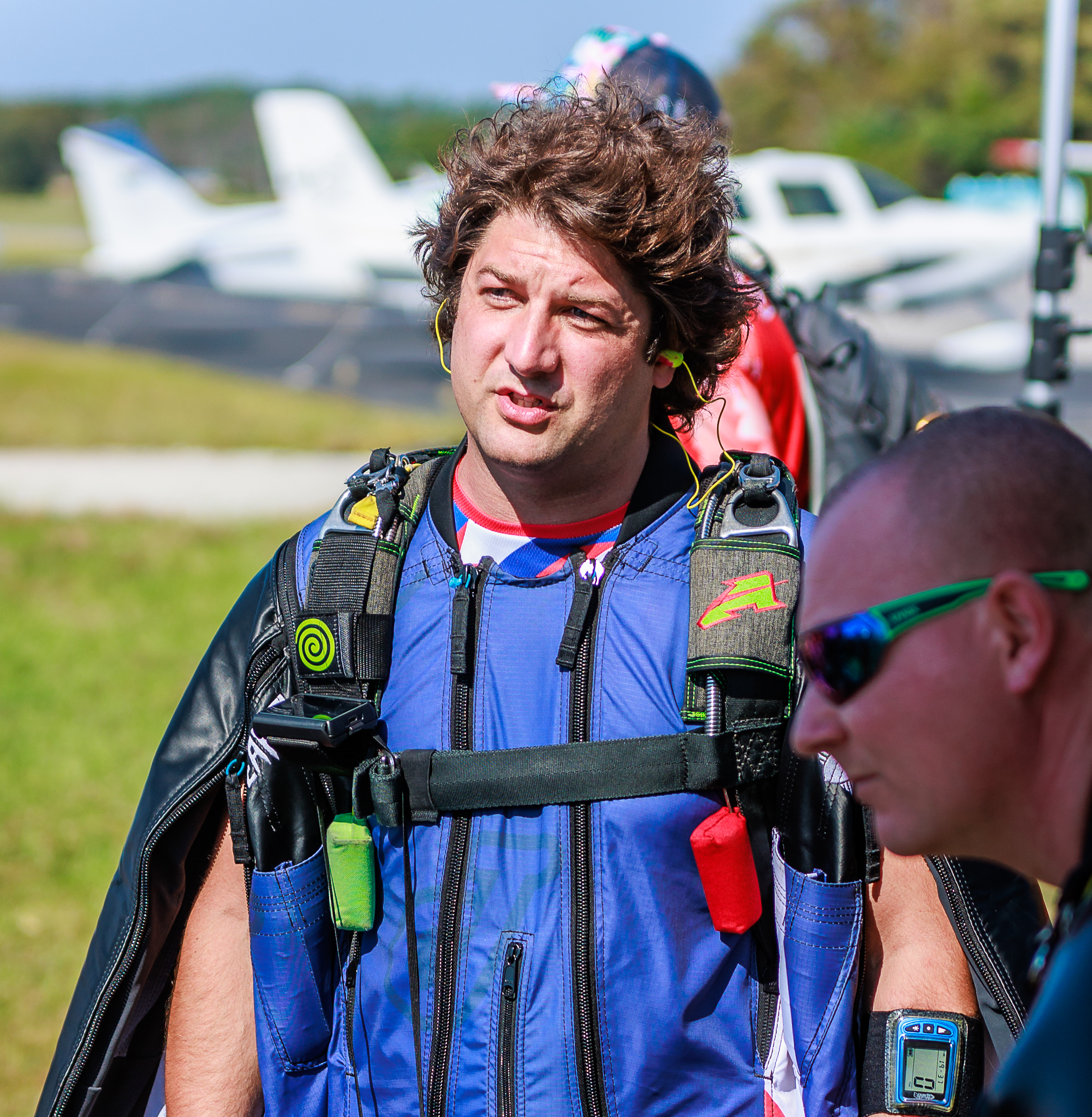
To explore that properly, I spoke with Fíona Jansen, an Indoor Wingsuit Coach at the Stockholm tunnel and one of the sharpest voices in the sport when it comes to progression, body awareness, and skill development.
For a lot of people, that feels like progression. Bigger suits dominate the videos people watch. Bigger suits dominate many of the events they see. Bigger suits are often what people picture when they think of “real” wingsuiting. Fíona Jansen called this out directly in our conversation, when newer wingsuiters look online, they usually imagine a Freak or something bigger, not a beginner suit.
And that is where the problem starts.
Because bigger suits are often treated like the destination, when in reality they should be the consequence of mastery.
If you want a healthier way to think about development, start with the wingsuit progression system, which focuses on skill development rather than just suit size.
Bigger suits are visible. That does not make them the goal.
One of the biggest reasons people want to upsize too early is simple: it is what they see.
They see big flocks. They see wingsuit BASE clips. They see people in large suits doing “serious” looking flying. What they do not see much of is someone doing genuinely high-level flying in a smaller suit. Fíona Jansen put it beautifully: it is way cooler to do something super advanced in a small suit than something very average in a big suit, but that is not the version of wingsuiting most people are exposed to.
That creates a subtle cultural pressure.
The beginner suit starts to feel like a waiting room. Something to get through. Something you tolerate until you can “properly” progress.
But that mindset is flawed from the beginning.
Because the point of a smaller suit is not just to survive your early flights. The point is to build the body awareness, control, recovery skills, and movement quality that will make every future stage of your progression better.
The events scene does not always help
There is also a practical side to this.
Many events naturally end up catering more to bigger suits. Not always because coaches think that is ideal, but because that is where the numbers often are. Fíona made the point that running beginner-friendly events is harder financially and harder logistically, especially when lower-skill flyers often need smaller groups, more attention, and more deliberate coaching.
So the result is predictable: newer flyers look around, see bigger suits as the norm, and start thinking that upsizing is simply the next box to tick.
It is not. Or at least, it should not be.
Jump numbers do not decide readiness
This is where a lot of people want a clean answer.
“How many jumps until I can fly X suit?”
Manufacturers often publish numbers. National bodies may discuss numbers. Drop zones like numbers because they feel objective and easy to apply.
But jump numbers are only ever a rough average.
As Fíona said, you can do a lot of useless jumps, or you can do a smaller number of very dedicated jumps with good coaching, focused objectives, and proper feedback. Those two pilots may end up in completely different places, even if the raw jump count looks similar.
A pilot with 100 wingsuit jumps who has spent most of that time flying solo, flying vaguely, and never really understanding their speed, glide, slot discipline, or recovery ability may be far less ready than someone with fewer but much more deliberate jumps.
Jump numbers matter. They just do not tell the whole story.
Tunnel time does not decide readiness either
The same is true in the wingsuit tunnel.
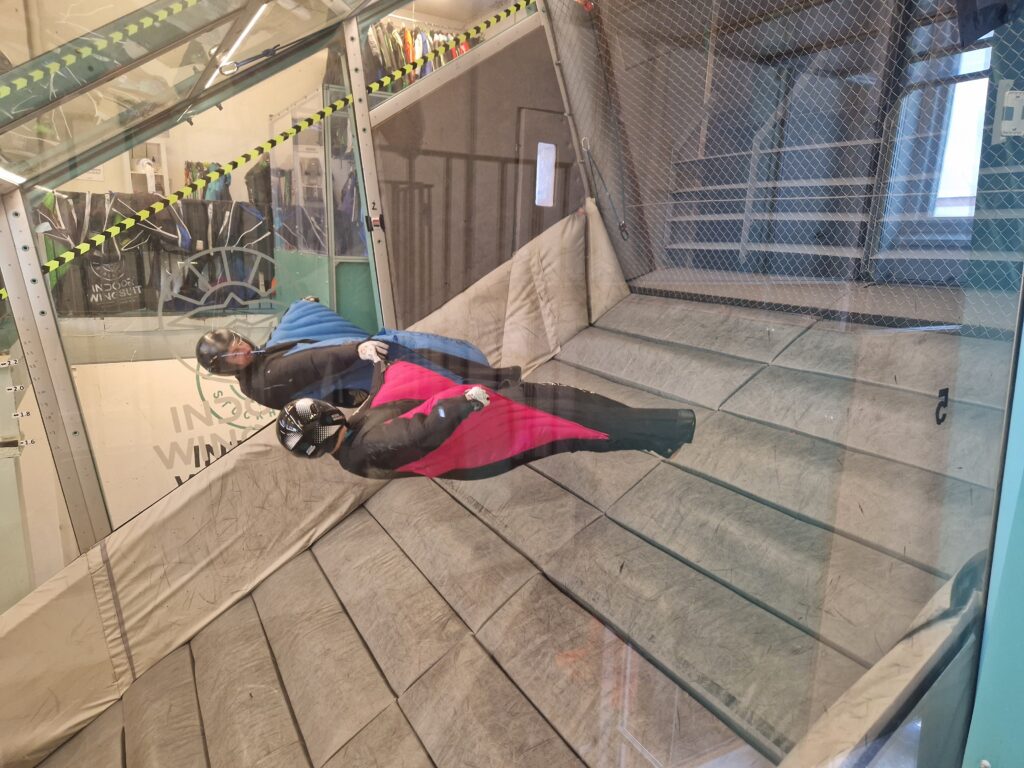
Tunnel flying can massively accelerate learning. It can clean up body position, reveal weaknesses, improve transitions, and build confidence. It can absolutely make someone a stronger flyer. Fíona is very clear on that. But she is equally clear that tunnel time does not replace sky experience. You still have to learn exits and deployments properly, and those are two of the most important safety elements in wingsuit flying.
So no, the answer is not “just use jump numbers.”
But it is also not “just use tunnel hours.”
Upsizing is not based on one metric. It is based on whether the pilot has actually earned more suit.
What most people get wrong about bigger suits
This was one of the strongest insights from the conversation.
Fíona said that in a small suit, you have to control your suit. In a big suit, the suit controls you. That is such an important distinction.
Why?
Because a bigger suit can flatter weak flying.
It can make a pilot feel more capable than they really are. It can let them get away with lazy legs, poor body position, rough movement, or incomplete control, at least until something goes wrong.
And that is exactly why some people confuse visible progression with real progression.
Yes, a bigger suit may let someone fly in a straight line and look relatively competent. But that does not mean they are actually progressing in the deeper sense. In fact, sometimes they are just building bad habits in a more powerful tool.
The cost comes later.
Transitions take longer to truly master. Recovery becomes harder. Approaches get more dangerous. Slot-flying becomes twitchier. Openings become messier. What looked like progression at first turns into a longer route to real skill.
“Be a ninja in your current suit” is still the best advice
This is the phrase I keep coming back to, and Fíona strongly resonated with it.
If you are not in a massive rush, stay in your small suit longer. Become a real ninja in it.
What does that actually mean?
Not just surviving a few jumps and feeling reasonably comfortable. Not just belly flying in a straight line. Not just being “fine.”
It means you can:
- fly solidly on your belly
- fly solidly on your back
- transition with control
- regain stability if you go unstable
- vary your angle and range with intent
- hold a slot with another flyer
- stay relaxed rather than tense
- deploy cleanly and consistently
Fíona even went further: if you have never found yourself on your back, or never intentionally explored instability and recovery in a controlled way, why would you add more fabric that may spin you even faster when something goes wrong?
That is the heart of good progression.
Not “can I get away with this suit?”
But “do I actually own the one I am already flying?”
What being “ready” looks like
If you want a more practical answer, here it is.
A pilot may genuinely be getting close to upsizing when they look relaxed in the suit. They can fly on their belly and back without tension. They can make mistakes without spiralling into loss of control. They can transition, recover, laugh, reset, and carry on. They have good exits. They have good deployments. They do not look like they are fighting the suit.
That relaxed piece matters more than many people realise.
Tension causes problems. Panic causes problems. Over-controlling causes problems. A lot of flat spins come from someone being too tense in a suit rather than moving naturally and staying ahead of it.
Real readiness usually looks calm.
The red flags that say “not yet”
This part matters just as much.
According to Fíona, the clearest giveaways that someone is not ready to upsize are:
- bad exits
- bad deployments
- inability to stay still in a flock
- too much movement when trying to hold slot
- needing to learn basic approaches and formation discipline in a more powerful suit instead of a safer one first
And to be blunt, if you cannot fly a slot well on your belly or your back, then upsizing into a bigger formation environment is not just a risk to you. It becomes a risk to other people too. Fíona was very direct about that.
This is one of the most important mindset shifts in all of wingsuiting:
Suit progression is not just a personal decision. Once you start flying with others, your progression affects everyone around you.
The canopy analogy is uncomfortable, and useful
This is why the canopy comparison is so powerful.
In canopy progression, most people understand that downsizing too early is a margin problem. It is not just about whether you can land the thing on a good day. It is about whether you have really built the judgement and consistency to handle the bad day too.
Wingsuit progression is similar.
The problem is not ambition. Ambition is good.
The problem is asking, “What’s next?” before asking, “What can I still improve here?”
That is the wrong question in canopies, and it is the wrong question in wingsuits too.
Small suits are not boring. They are revealing.
One of the most valuable points from the tunnel side of the conversation is that smaller suits expose what your body is really doing.
In the tunnel, Fíona said one of the readiness checks they use is removing reliance on the suit itself: flying without arms, without legs, or asymmetrically, to prove that the flyer is actually flying their body rather than just leaning on the fabric.
That idea transfers beautifully to the sky.
Smaller suits reveal weakness earlier. They force cleaner inputs. They demand better use of core, better leg discipline, better transitions, and better recovery.
That is why time in a smaller suit is not time wasted.
It is usually where the foundations are either built properly or skipped.
So when is it actually time to upsize your wingsuit?
Here is the honest answer.
It is probably time to upsize when your current suit no longer feels like something you are merely managing, but something you genuinely command.
Not because you have hit a certain number.
Not because you have done some tunnel hours.
Not because your mates are all in bigger suits.
Not because the event scene makes you feel left behind.
It is time when your current suit looks calm, deliberate, predictable, and deeply understood.
It is time when your exits are good, your deployments are good, your slot-flying is solid, your backflying is comfortable, your transitions are under control, and your recovery is proven.
And even then, there is no prize for rushing.
Final thought
If you take one thing away from this, let it be this:
Do not chase a bigger suit because it looks like more fun. Chase the level of skill that makes moving on the obvious next step.
Or, in Fíona’s words: be patient and learn to be a ninja in your uncool suit. The flyers she respects most are not the people doing average things in big suits, but the humble pilots doing really cool things in small ones. Over time, that pays off.
And honestly, that is still some of the best wingsuit progression advice you will hear.