

350 Feet and No Engine: What Wingsuiters Can Learn from Hans’s Caravan Crash
When the Caravan carrying Hans and 17 other skydivers lost its engine at just 350 feet, there was no time for a second attempt or a lengthy briefing. Everyone survived, but the incident offers some important lessons about seatbelts, door management and emergency readiness, particularly for wingsuiters sitting at the front of the aircraft.
When the Caravan carrying Hans and 17 other skydivers lost its engine at just 350 feet, there was no time for a second attempt or a lengthy briefing. Everyone survived, but the incident offers some important lessons about seatbelts, door management and emergency readiness, particularly for wingsuiters sitting at the front of the aircraft.
Most aircraft rides become routine.
You get in, find your place, connect your seatbelt and start thinking about the jump. Perhaps you are visualising the exit. Perhaps you are checking the formation plan one more time. Perhaps you are simply waiting for the aircraft to reach an altitude where you can loosen everything and become slightly more comfortable.
The take-off itself rarely feels like part of the jump.
That is understandable. Serious aircraft emergencies are rare, and you cannot sit through every climb expecting the engine to stop. But rare does not mean impossible, and when something does happen close to the ground, you may have only seconds to respond.
For wingsuiters, there is an additional problem.
We are often sitting towards the front of the aircraft, surrounded by fabric, with tandems, students, instructors and fun jumpers between us and the door. In a normal climb, that is simply how the load works. In an emergency, it can leave you a long way from the only available exit.
At the recent Into Thin Air event in Sweden, we were given a presentation by Hans about an incident that brought all of this into sharp focus.
On 21 June 2021, the Caravan he was flying lost its engine at approximately 350 feet with 17 people on board.
Everyone survived.
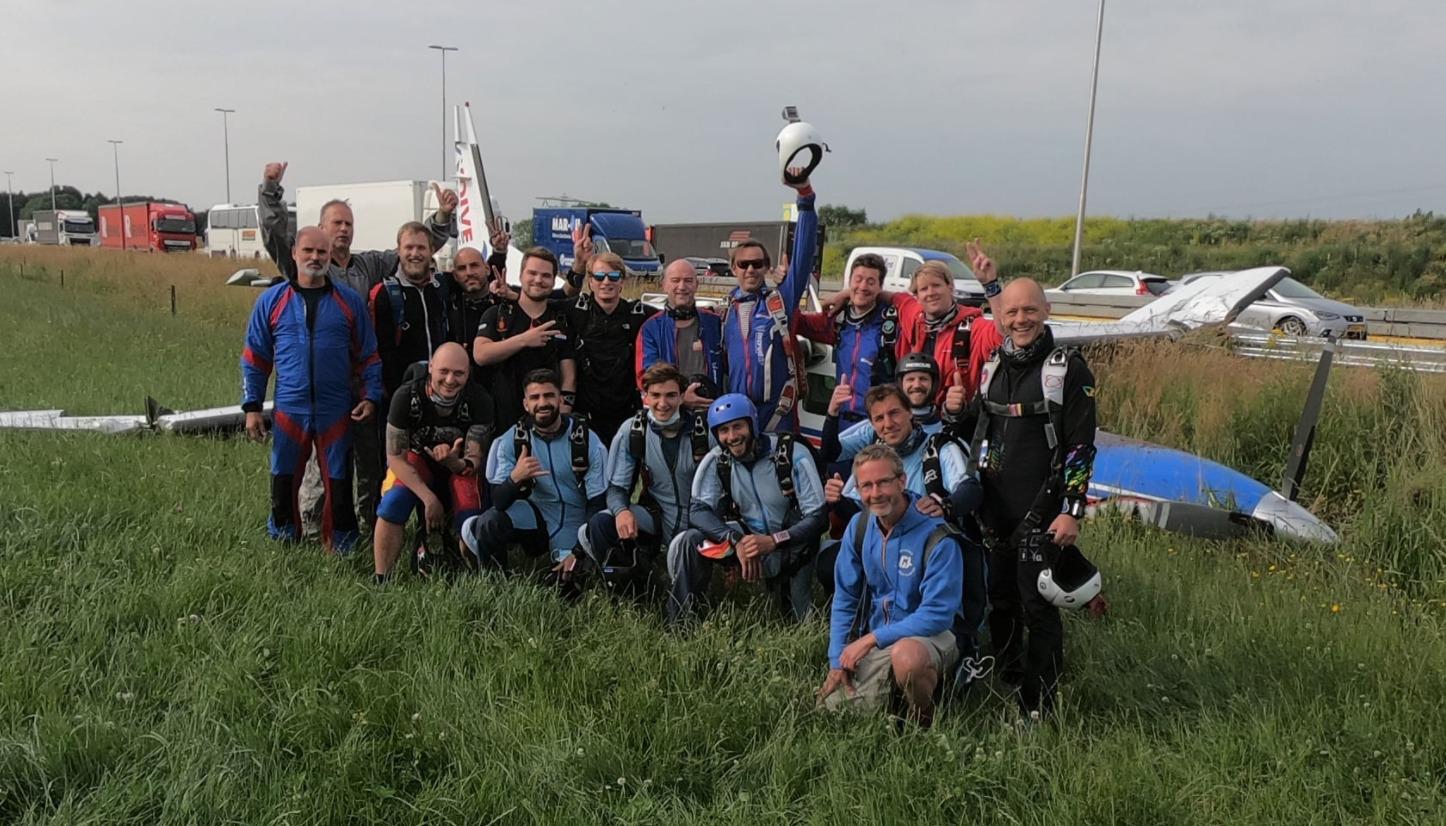
That outcome was not the result of one clever trick or one piece of equipment. It came from a series of decisions made by the pilot and the people inside the aircraft, combined with a considerable amount of good fortune.
The story is worth understanding, not because we should become frightened of the aircraft, but because it exposes the small details we regularly overlook.
At 350 feet, there was no time to discuss the options
There were 17 people aboard the Caravan: four first-time skydivers, eight instructors and a mixture of other jumpers.
Shortly after take-off, at approximately 350 feet, the engine stopped.
This was not a gradual loss of power. The propeller went into full feather and the engine stopped almost instantly.
At the time, nobody in the aircraft knew any of that.
Hans simply had an aircraft full of people, very little altitude and an immediate problem to solve.
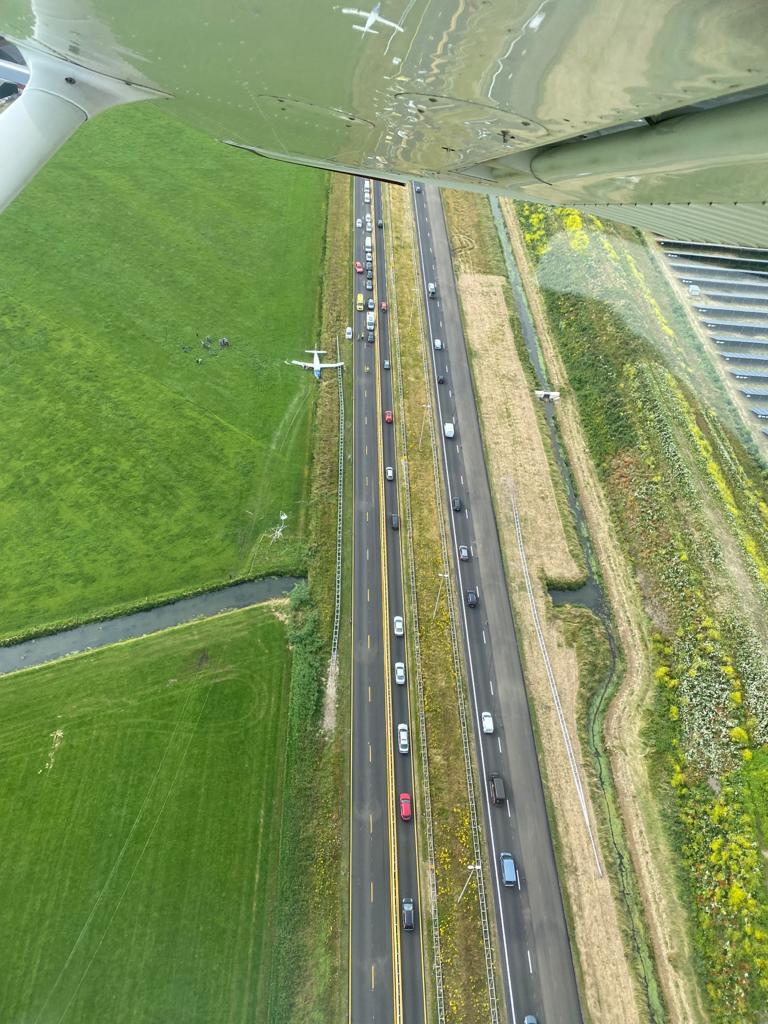
He pushed the nose forward to maintain airspeed and identified a small field beyond a highway. Reaching it required a 90-degree turn to the left.
The approach was far from clean. There was a ditch that Hans had not fully registered until they were almost on top of it. The aircraft crossed the ditch, lost its landing gear and struck a McDonald’s billboard with the right wing.
The impact spun the aircraft through approximately 180 degrees before it came to rest against a guardrail, supported partly by the left wing.
The Caravan was a total write-off.
Every person on board was able to get out.
The outcome was decided before the aircraft stopped moving
It would be easy to tell this as a story about Hans making an exceptional forced landing.
He did.
But one of the strongest points from his presentation was that the evacuation began before the aircraft had even touched the ground.
The jumpers nearest the door recognised what was happening. Liam a UK skydiver called for the door to be opened, and it was opened during the approach.
That decision mattered.
Once an aircraft hits the ground, the fuselage can twist, collapse or become obstructed. A door that worked perfectly during the climb may no longer move after impact. Even relatively minor deformation can prevent it from sliding or opening correctly.
In this incident, the door was already open.
As soon as the aircraft stopped, all 17 skydivers were able to run out into the field.
A rat catcher working nearby happened to photograph the group without initially understanding why 17 people wearing parachutes had suddenly appeared beside him.
Sam then called the drop zone.
“Can you come and get us?”
The initial response was understandable: “You just departed.”
“We just crashed.”
There is something almost absurd about that exchange, particularly when everyone involved was standing safely outside the aircraft. It could very easily have been a different phone call.
Opening the door did not prevent the crash.
It made the evacuation simpler when every second could have mattered.
Somebody near the door needs to know it is their job
On many loads, nobody is formally responsible for the aircraft door during an emergency.
Everyone assumes that the person closest to it will know what to do.
That may be true when the load contains experienced jumpers. It may be less reliable when the person at the door is a student, a first-time jumper or somebody who has never considered that the door might need to be opened before landing.
Hans referenced footage from the Lodi aircraft crash in which people could be heard shouting for the door to be opened, but action was not immediate.
It is difficult to judge decisions made by people during a real emergency. Noise, confusion, unusual aircraft attitudes and fear can make apparently simple tasks much harder.
That is precisely why the responsibility should be understood beforehand.
The person nearest the door does not need a complex briefing. They need to know what the door-opening procedure is, when it should be used and whether the pilot or jump leader will give the instruction.
That does not mean opening the door every time an engine note changes.
It means removing uncertainty when a genuine emergency is already unfolding.
Wingsuiters may be the least able to help
Wingsuiters will normally be towards the front of a Caravan or similar aircraft because we are usually among the last groups to exit.
During a normal skydive, that makes perfect sense.
During a take-off emergency, it creates several practical problems.
You may have the entire load between you and the door. Tandems may be positioned in front of you and will generally remain with the aircraft below their agreed emergency exit altitude. Students may be frightened or unable to respond quickly. Instructors may be focused on protecting or controlling the person they are responsible for.
You may also be wearing a large suit that restricts your movement more than ordinary freefly clothing.
It means we should take an interest in how the whole load is briefed, rather than assuming aircraft emergencies are solely the pilot’s responsibility.
Before take-off, you should understand:
- who is operating the door in an emergency
- the altitude at which the load may be instructed to exit
- when seatbelts should be removed
- whether tandems or students will remain in the aircraft
- how you will clear your own suit and equipment if evacuation becomes necessary
You may not be controlling the door, but you still need to understand the plan.
A seatbelt only works if it actually restrains you
Most skydivers will admit that, at some point, they have been casual about aircraft restraints.
Perhaps the belt was difficult to reach. Perhaps the extension was tangled underneath somebody. Perhaps the aircraft was already moving and connecting it felt less important than getting the load settled.
The issue is not whether the seatbelt is technically attached.
The issue is how far you can move before it begins to restrain you.
Long seatbelt extensions are common in some aircraft, particularly Caravans. They make it easier to reach around rigs and tightly packed jumpers, but they can also leave a significant amount of slack.
In a hard impact, that slack becomes travel distance.
You can be thrown forward, sideways or into the person in front of you before the restraint takes any meaningful load. Inside a crowded aircraft, even a relatively small amount of movement can cause serious injury.
Jack’s recommendation was simple: minimise unnecessary slack and review how extensions are being used.
Some drop zones may permit the belt or extension to be routed through an appropriate part of the harness to reduce movement, such as around the hip-ring area or through your three ring system.
The principle is more important than improvising your own solution.
Your restraint should prevent excessive movement, not merely allow you to say that you were connected.
Carabiners are not emergency-release systems
Some aircraft restraint setups use carabiners to connect jumpers or extensions to the aircraft.
The problem appears when the connection is under load.
A standard carabiner can be extremely difficult, or impossible to disconnect while it is being pulled tight. If the aircraft ends upside down or on its side, your body weight may remain suspended through that connection.
Matt referred to footage from the Lodi incident, where inverted occupants appeared unable to release themselves from their restraints.
The restraint had done part of its job by holding them during the crash. It then became an obstacle during evacuation.
This is why purpose-designed quick-release systems are preferable. They are intended to be disconnected under load, rather than requiring the user to create slack before the gate can be opened.
This is not something an individual jumper can necessarily change while boarding the aircraft. It is something worth raising with the drop zone owner, chief instructor or aircraft operator.
Ask what restraint system is being used.
Ask whether it can be released while loaded.
Ask whether the extensions are longer than they need to be.
Those are reasonable questions, not criticism of the operation.
A loose helmet becomes part of the crash
It is common to see people board with their helmet unclipped or resting on their lap.
Perhaps the helmet is uncomfortable. Perhaps the jumper is planning to put it on later in the climb. Perhaps they simply do not want to sit wearing it for 15 minutes.
During take-off and landing, an unsecured helmet is not protective equipment.
It is a projectile.
The same applies to cameras, phones, weight belts and anything else that has not been properly secured.
In a sudden stop, loose objects continue travelling. Inside an aircraft carrying 17 people, they do not have far to travel before hitting somebody.
Fastening your helmet for take-off is a small inconvenience.
It is difficult to justify not doing it.
Emergency exit altitudes are not universal
One of the most confusing areas is deciding when jumpers should exit an aircraft with a problem.
There is no single altitude that applies to every aircraft, drop zone or type of load.
A common principle is that below an agreed altitude, everyone remains inside and prepares for a forced landing. Above that altitude, the pilot may instruct jumpers to exit.
Some operations use approximately 1,000 feet as a decision point. Others use 1500 feet, allowing more time for a full load to leave the aircraft. In the UK, emergency procedures may use a figure closer to 2,000 feet, particularly because a large aircraft load can take a significant amount of time to exit.
The first person may leave with plenty of altitude.
The wingsuiter sitting at the front may not.
Tandems also have their own minimum emergency exit requirements and will generally remain in the aircraft until reaching an altitude at which a safe emergency deployment is possible. Worth clarifying?
Students introduce another layer of complexity. If the aircraft is above an appropriate reserve deployment altitude, an instructor may direct a student to leave and deploy their reserve.
In theory, that is straightforward.
In reality, a first-time jumper experiencing an aircraft emergency may be frightened, disorientated or unable to process instructions. An AAD provides an important final safety layer, but it should not be treated as a replacement for a workable emergency procedure.
The correct altitude and procedure will depend on the aircraft, the operation and the people aboard.
You should know your drop zone’s plan before the engine stops.
The pilot’s instruction is not a group discussion
In the air, the pilot’s decision is absolute.
The jumpers do not have the information, visibility or aircraft knowledge required to debate whether the aircraft can return to the runway, reach a field or continue climbing.
If the pilot says remain seated, remain seated.
If the pilot or jump leader says exit, exit.
If the instruction is to open the door, the nominated person needs to act.
This does not mean pilots are incapable of making mistakes. It means an aircraft emergency at low altitude is not the moment for 17 separate people to create 17 separate plans.
After the aircraft has landed, the priority changes.
Once the aircraft has stopped, you should get out immediately unless there is an obvious reason that your exit would create a greater danger. Do not remain seated waiting for another instruction simply because the pilot made the decisions in the air.
There may be fuel leaking.
There may be fire.
The aircraft may be unstable or partially supported by damaged landing gear or a wing.
In Hans’s incident, the Caravan came to rest against a guardrail. The jumpers did not wait to see whether it would move again.
They got out.
What wingsuiters should review at their home drop zone
Hans’s presentation was not about creating fear around Caravan operations.
The investigation confirmed that the failure was linked to the incorrectly installed sensor probe. It was a specific mechanical fault, not evidence of a wider generic problem with the aircraft or engine.
The engine itself survived the impact and was sent to Denmark for further analysis.
The financial aftermath was less straightforward. The aircraft was written off, the insurer initially refused to renew the policy and later offered cover at around five times the previous premium.
Those details make the story memorable, but they are not the main lesson.
The useful question is what you can change because you have heard it.
At your home drop zone, review the following:
- Seatbelt extensions: Are they unnecessarily long, and how much movement do they allow before restraining you?
- Release systems: Are carabiners being used, and can the restraint be released while it is under load?
- Door responsibility: Does the person nearest the door understand what to do during a forced landing?
- Emergency altitudes: Do you know the unhook altitude and the point at which jumpers may be instructed to exit?
- Load order: As a wingsuiter at the front, do you understand how tandems, students and other groups affect your path to the door?
- Personal equipment: Is your helmet fastened, your suit controlled and your route out of the aircraft reasonably clear?
You do not need to interrogate the pilot before every load.
A short, sensible conversation with the drop zone can answer most of these questions.
Preparation should feel unnecessary most of the time
Almost every time you fasten your helmet, shorten a loose restraint or clarify who is operating the door, nothing will happen.
The aircraft will climb normally.
You will remove your seatbelt at the agreed altitude, prepare your suit, make your exit and barely think about the precautions you took on the ground.
That is how safety measures are supposed to feel.
Hans did not know that the sensor probe installed that morning was incorrectly seated. The jumpers did not know the engine would stop at 350 feet. They did not have time to create a plan once it happened.
They relied on the pilot maintaining control, somebody recognising that the door needed to be opened and the load being able to evacuate quickly.
Everyone walked away.
That does not make the incident harmless. It makes it useful.
The next time you board an aircraft, take a moment to look at your restraint, fasten your helmet and understand who is responsible for the door.
You will probably never need any of it.
But at 350 feet, “probably” is no longer much help.
The checklist, the debrief template and the upsize framework - bundled as one guide, free for the network.
Other things worth reading.


Want this kind of thinking, monthly?
New episodes, field notes and event drops. One email a month. No marketing fluff, no hype.