

Your First Hour in a Wingsuit Tunnel: What to Expect
Your first hour in a wingsuit tunnel can be humbling, eye-opening and more physical than you expect. Here is what actually happens, why everyone starts with the safety system, and how to get the most from the experience.
Your first hour in a wingsuit tunnel can be humbling, eye-opening and more physical than you expect. Here is what actually happens, why everyone starts with the safety system, and how to get the most from the experience.
There is something slightly strange about walking into a wingsuit tunnel for the first time.
Even if you have already done wingsuit jumps. Even if you are comfortable in the sky. Even if you have watched the videos, spoken to people who have been, and convinced yourself that you know roughly what is coming.
The first session still has a way of resetting you.
Not in a bad way. More in the sense that it strips everything back. It removes the aircraft, the exit, the navigation, the deployment, the group plan, the altitude awareness, and all the usual noise of a wingsuit skydive. What you are left with is much simpler, but also much harder to hide from.
You, the suit, the wind, and the coach.
That is why, when I asked Arvid Endler from Inclined Slovenia how he would describe the first wingsuit tunnel experience, his answer was simple: humbling and eye-opening.
And I think that is about right.
Because your first hour in a wingsuit tunnel is not really about becoming brilliant. It is about understanding what the tunnel is, what it is not, and what it starts to reveal about your flying.
The wingsuit tunnel is not just a normal tunnel on its side
It is tempting to compare the wingsuit tunnel to a vertical wind tunnel, because that is the closest reference point most skydivers have.
But it is not the same thing.

Yes, both give you flight time. Both give you coaching. Both give you repetition. But the wingsuit tunnel has its own learning curve, its own physical demands, and its own way of exposing tension, balance, and body position.
The biggest surprise for many people is how quickly fatigue can arrive.
In the sky, you have short windows. In the tunnel, you are in the wind again and again, trying to process a lot of information while holding a body position that may not yet feel natural. If you are tense, especially through the shoulders and arms, the workload ramps up quickly.
That is one of the first lessons.
The wingsuit tunnel does not reward brute force. It rewards relaxation, patience, and precision.
Your first hour is not about tricks
This is probably the most important expectation to set.
Your first hour in the tunnel is not about showing off. It is not about transitions, carving around, backflying, or flying like the people you have seen in clips online.
It is about learning the basics properly.
That might sound boring, but it really is not. Because the basics in the tunnel are not small things. They are the things that everything else is built on.
- Can you find a neutral body position?
- Can you relax enough to let the suit fly?
- Can you create lift without just hanging off your arms?
- Can you steer with small inputs?
- Can you move without overreacting?
- Can you land safely?
- Can you stay calm when it feels weird?
That is the work.
And that is why the first hour can feel so valuable.
What happens when you arrive?
The first part is not flying. It is orientation.
You will normally be shown the facility, how the sessions work, where to get ready, where to rest, and what the process will look like. If you are there for a few days, which many people are, that matters more than you might expect. You are not just arriving for a quick blast of wind. You are settling into a training environment.
Then comes the briefing.
This will usually cover how to enter the tunnel, how the safety systems work, what the first session is likely to involve, and the first basic flying concepts: neutral position, relaxation, steering, lift, and how the progression works.
After that, you get kitted up.
You do not need to arrive with a full set of wingsuit tunnel equipment. The tunnel provides the required gear. What you do need is comfortable clothing and comfortable shoes. If you want to bring your own helmet, it needs to be impact-rated and suitable for the environment.
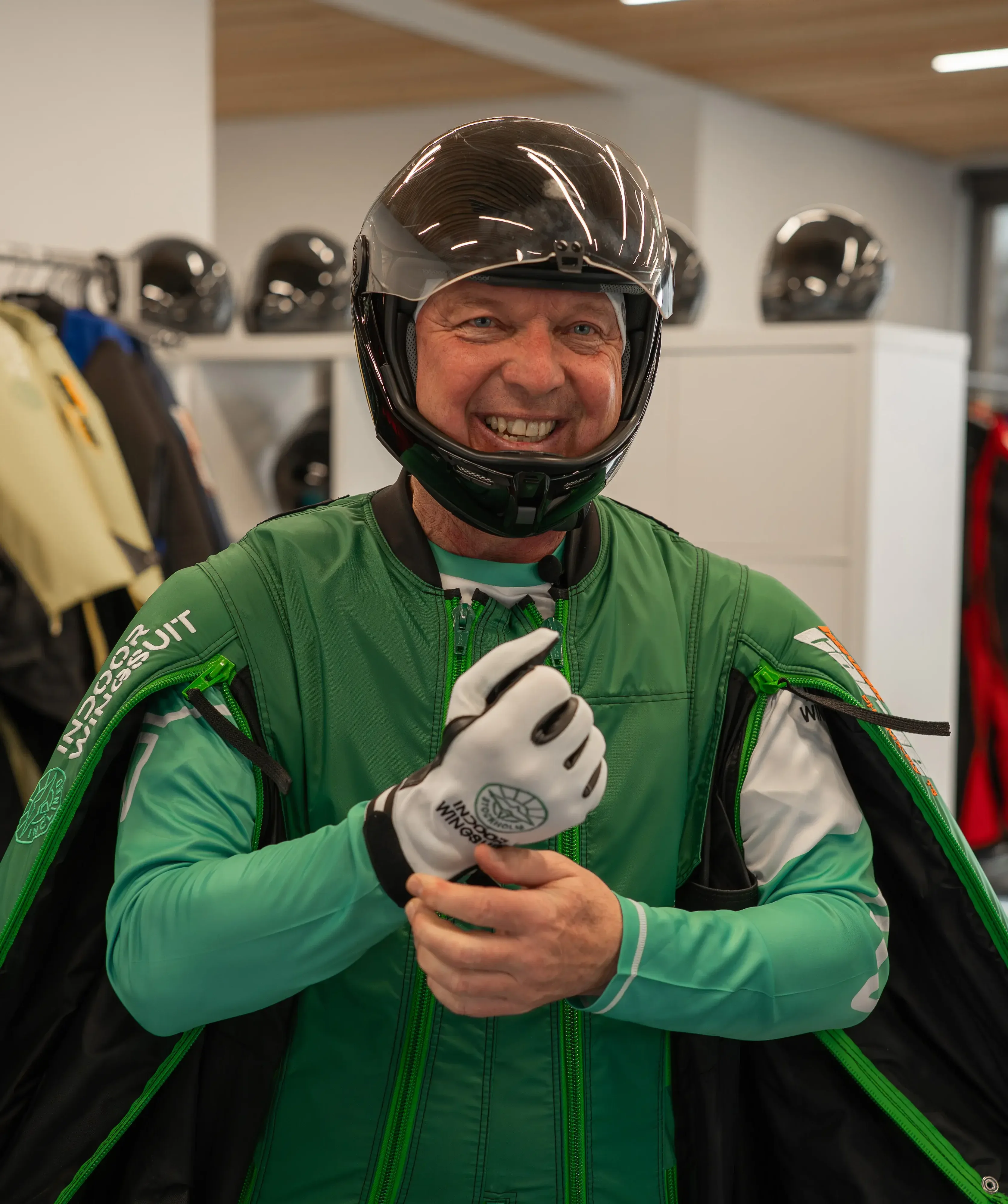
Then you go into the tunnel.
And that is where the real learning starts.
Why do you start on ropes?
For most first-time tunnel flyers, the first phase is on the rope system.
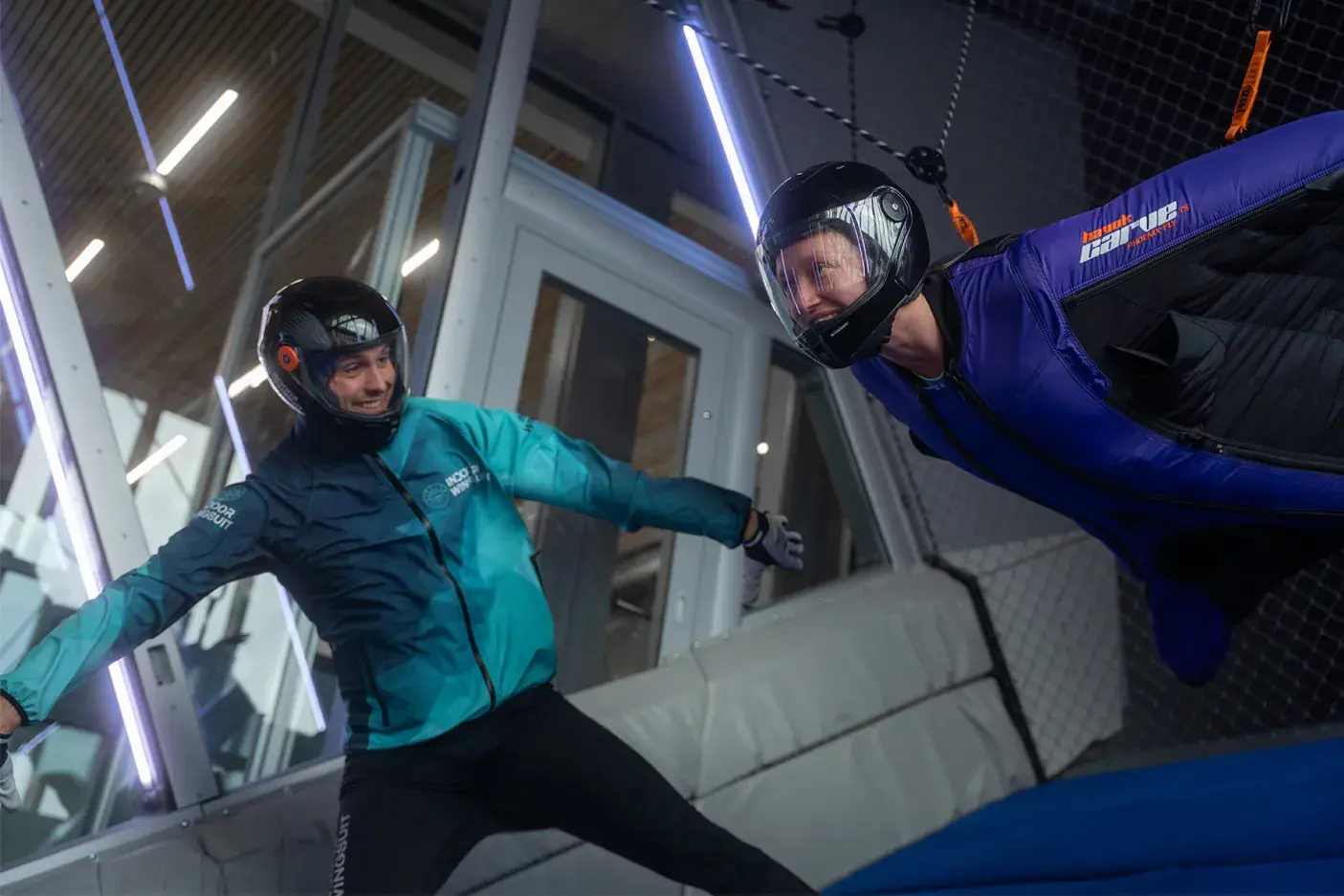
That can feel strange at first.
You are in a wingsuit, wearing a harness under the suit, and connected to ropes that prevent you from falling, reaching the walls, or getting completely away from the coach. The coach is beside you, able to stabilise you, slow you down, stop you from going too high, and help manage the early parts of the process.
If you have wingsuit experience already, this can feel like a bit of a reset. The harness may feel like it is pulling you back toward the middle. It may feel less natural than flying freely. That is normal.
The point of the ropes is not to make the flying feel perfect. The point is to give you a safe space to start learning the right movements.
It is there so you can make mistakes without those mistakes becoming a problem.
What should you expect in the first 30 minutes?
Everyone progresses differently, so it is important not to treat this as a promise.
But a realistic goal for the first 30 minutes is to start understanding neutral body position, relaxation, basic lift, and the first simple inputs.
That usually means learning how to speed up, slow down, steer left and right, create lift, and land safely. One of the first things the coach may show you is how much your head affects your direction. From there, the work usually starts moving into shoulders, arms, hips, core, and chest.
This is where the tunnel becomes very honest.
The goal is not to smash through the process. The goal is to build enough understanding and control that the coach no longer needs the ropes to support you.
That might happen quickly for some people. It might take longer for others. Arvid’s view was that many people move from ropes to the next stage somewhere between around 20 minutes and an hour, but the exact timing is not the point.
The point is control.
From ropes to leash
Once you can fly with enough stability, manage basic movements, and land safely, the next stage is usually the leash.
This is the point where things start to feel more like flying.
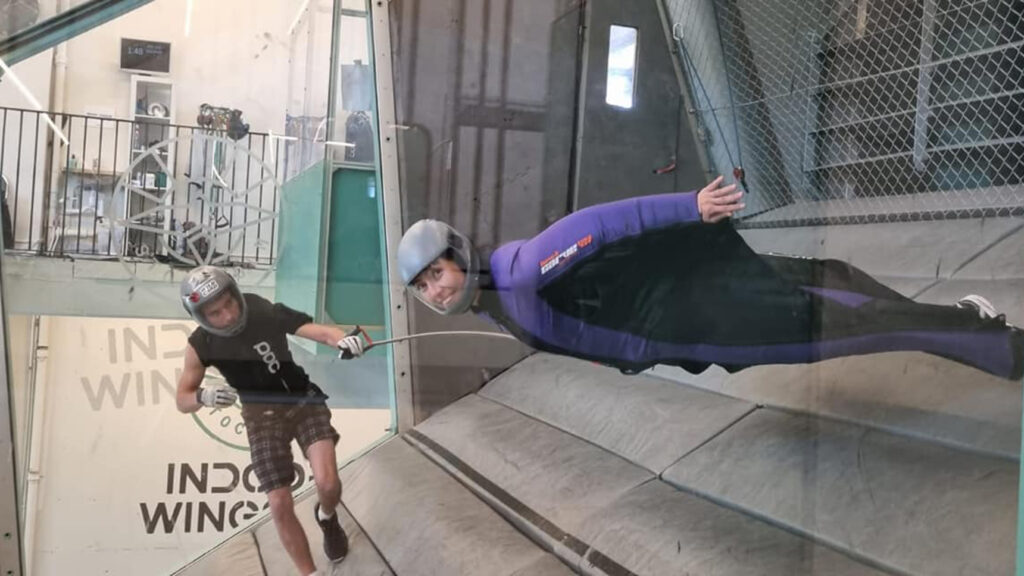
On the leash, you are still connected to the coach, but they are no longer holding you up through the rope system. You have to create your own lift. You have to maintain your own level. You have to fly the suit more independently.
The coach can still help. They can pull you back if needed, assist with landings, and stop you fully escaping the safe area. But this stage puts more responsibility back on you.
I remember this feeling clearly.
There is a moment when the coach gives you more freedom and part of your brain goes, “No thanks, you can keep holding onto me.” But when you start to hold yourself there, when you feel the suit working and you realise you are actually flying it, it is incredible.
That is one of the first magic moments.
Why does it feel so physical?
Because it is.
A lot of people underestimate this before they arrive.
The first hour can be tiring, especially if you are tense. You may feel like you are working constantly through your shoulders, arms, core, and legs. You may come out sweating even though the tunnel air is cool.
That does not mean you are doing badly. It just means you are learning something new.
But it does matter.
Fatigue is not good for learning. Once you get tired, you often get tense. Once you get tense, your inputs get worse. Once your inputs get worse, you start reacting rather than feeling.
That is why more tunnel time is not always better, especially at the start.
For a first visit, less can genuinely be more. It is better to fly a sensible amount, stay fresh, absorb the information, and come back ready to learn again than it is to keep forcing time when your brain and body are already full.
The biggest early lesson: stop fighting the suit
One of the most common early breakthroughs is realising that you do not need to use your arms as much as you think.
This is a huge one.
Most people arrive with some version of “wingsuit flying means arms out, hold pressure, push hard.” And yes, there is pressure in the suit. Yes, there is tension in the body. You are not completely floppy.
But there is a massive difference between useful structure and fighting the wind.
Arvid described it like standing upright. Your muscles are active enough to support you, but you are not fully flexing every part of your body. Good tunnel flying is similar. There is tone, but not panic. Support, but not stiffness.
When people start to feel that, everything changes.
They realise they can use the body more. They can trust the lift created by a longer body position. They can let go of unnecessary arm tension. They can start flying with more precision and less effort.
That is often the first real click.
Why slowing down makes you progress faster
This sounds backwards, but it is probably the most useful advice in the whole conversation.
If you want to learn quickly in the tunnel, slow down.
Most people try to move too fast. Not necessarily fast from the outside, but fast relative to what their brain can actually process. They put in an input, move too much, react to that movement, overcorrect, react again, and suddenly they are not learning. They are chasing.
The better approach is to make the input slowly enough that you can feel what is happening.
If you want to go forward, do not just throw the full input at the suit. Start gently. Increase the input slowly. Feel the moment the movement begins. Stay ahead of it.
That is how you learn what actually caused the movement.
If you rush, you might get a result, but you will not necessarily understand the result. And if you do not understand it, you cannot reliably repeat it.
The slower you are willing to go at the start, the more precise you become later.
Can the tunnel help before a First Flight Course?
Yes, massively.
That does not mean everyone must do it before their First Flight Course. People have been learning to wingsuit without tunnel time for years. But if you do get time in the tunnel first, it can remove a lot of stress from that first jump.
Think about what happens on a first wingsuit flight.
- You are thinking about the exit.
- You are thinking about stability.
- You are thinking about navigation.
- You are thinking about altitude.
- You are thinking about the coach.
- You are thinking about the deployment.
That is a lot.
If you already know what the suit feels like in the wind, if you already understand basic stability, if you have practised slowing down, speeding up, looking around, and moving your arms without losing control, then you free up mental capacity.
You can focus more on the exit. You can focus more on the flight plan. You can focus more on the pull.
The tunnel does not replace sky training. It does not teach you everything. But it can make the first sky experience feel far less overwhelming.
Can experienced wingsuiters benefit too?
Absolutely.
In fact, for experienced flyers, the first tunnel session can be even more humbling.
If you have a few hundred wingsuit jumps, you may arrive with a fairly strong idea of who you are as a flyer. Then the tunnel takes away the noise and shows you the detail.
Maybe you rely too much on your arms.
Maybe your legs are lazy.
Maybe your head position is driving inputs you did not realise you were giving.
Maybe you are used to flying in a performance position, but not necessarily with precision.
Maybe you can fly well in the sky, but have never had this level of constant feedback.
That is not a criticism. That is the point.
The tunnel gives you a clearer mirror.
And it does not matter what level you are. You still go through the same process. You may move through the early safety stages quicker, but you still have to show stability, control, landings, and awareness before moving on.
What bad habits show up quickly?
The big one is trying too hard.
A lot of skydivers arrive with a performance mindset. Head down, shoulders stiff, arms loaded, everything pointed forward and driven by effort.
That might work well enough for certain types of flying outside, especially if the goal is simply to cover distance or fly with power. But if you want precision, it becomes limiting.
Precision starts with relaxation.
Once you can fly stable and relaxed, the coach can start isolating body parts. What happens if you move only the shoulder? What happens if you move only the head? What happens if you adjust the hips or chest?
That is where the detail lives.
The tunnel gives you the time and feedback to understand those inputs properly. Not just in theory, but in your body.
What happens after your first few sessions?
One of the most valuable parts of tunnel training is the coaching loop.
- You fly.
- You get feedback.
- You watch the video.
- You go back in.
- You adjust.
- You feel the difference.
- You repeat.
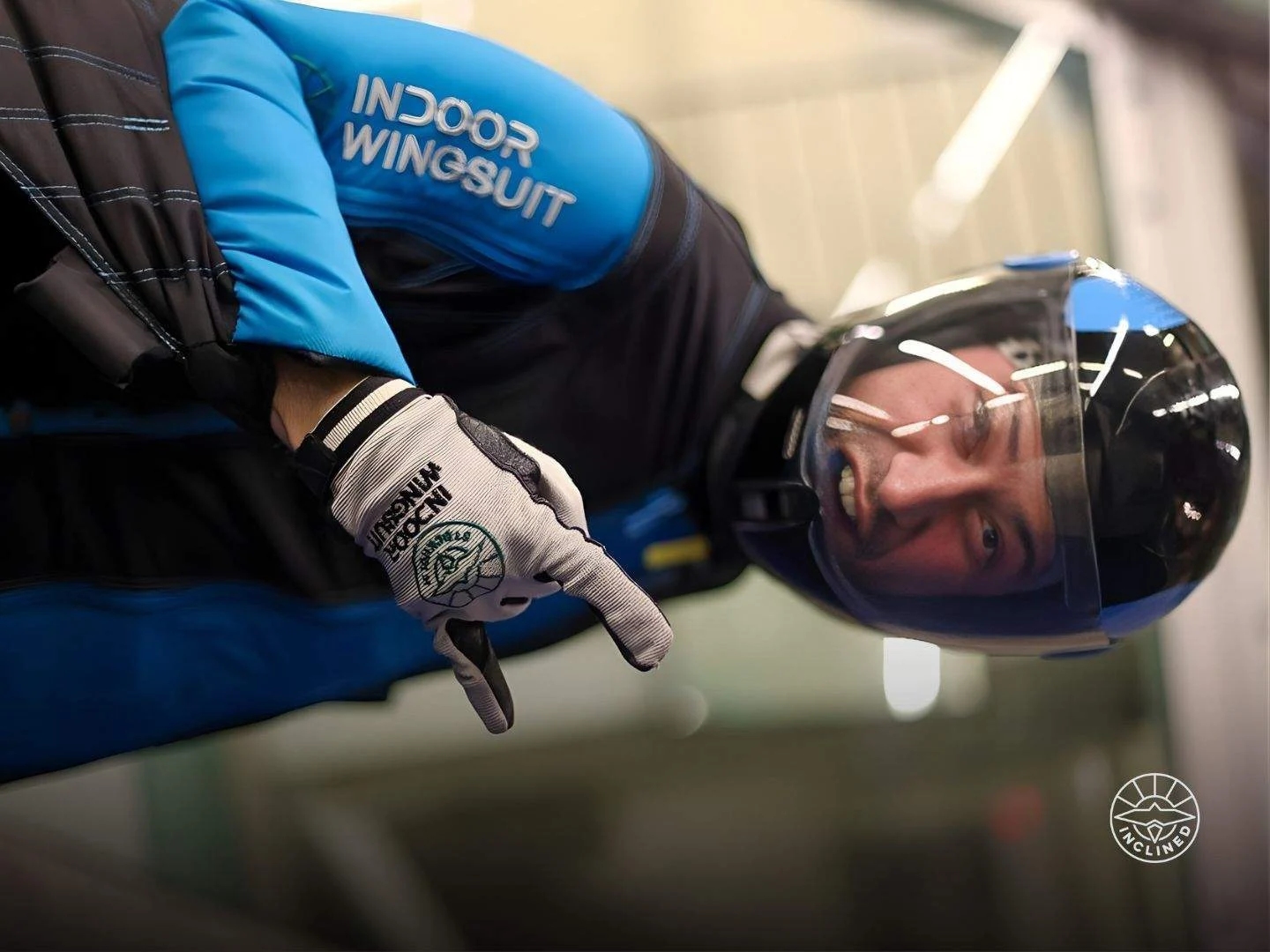
That loop is incredibly hard to recreate in the sky.
On a skydive, the coach may have to chase you, stay in frame, manage the formation, fly their own slot, watch altitude, and then debrief everything after landing. In the tunnel, the coach can often stay directly in your field of view and give you real-time input.
The feedback is immediate.
That is why progress can feel so concentrated. It is not just more flying. It is better-quality repetition.
What should you expect when you go back to the sky?
This depends on your level, but most people notice more control.
You may find it easier to hold a slot. Easier to look at people. Easier to adjust level. Easier to feel what the suit is doing. Easier to stay calm because your body now has more reference points.
That does not mean the tunnel gives you everything.
You still need sky experience. You still need exits. You still need navigation. You still need deployments. You still need judgement. And one thing to be aware of is that tunnel flying, especially early on, is often done at a moderate, controlled speed for learning. So when you return to the sky, you may need to remember to bring the speed back in where appropriate.
But the biggest difference is usually capacity.
You have more room in your head because the basic flying takes up less of it.
That is the real value.
How much tunnel time is too much?
This is worth taking seriously.
The tunnel is addictive, and once you start feeling progress, it is very tempting to keep going. But more is not always better.
In the beginning, Arvid’s guidance was that around 40 minutes on a first day is often enough, and that first-time tunnel flyers should normally be careful about doing more than an hour per day. If you are doing consecutive days, fatigue builds quickly, both physically and mentally.
At some point, your progression may flatten. You are not necessarily getting worse, but you are no longer absorbing much either. You are just hovering around the same level.
That is where rest becomes part of the training.
If you are doing a longer trip, a good rhythm may be a few days of flying followed by a rest day. Let the body recover. Let the brain process. Come back fresh.
It is not wasted time.
Sometimes it is the thing that allows the next jump in progression.
Who is the tunnel actually for?
This is one of the best things about it.
The tunnel can be valuable for people at very different stages.
If you have never skydived, it can be a unique first taste of wingsuit flight. You can experience being lifted, steering, and moving in a wingsuit without needing to go through months or years of skydiving first.
If you are preparing for a First Flight Course, it can reduce stress and give you a much cleaner starting point.
If you are a newer wingsuiter, it can build confidence, control, and awareness.
If you are experienced, it can refine the details and expose habits you may not have realised you had.
The experience is different for each person, but the underlying value is the same.
It gives you time in the wind with direct feedback.
What should every first-time tunnel flyer understand?
Trust the process.
That may sound like a cliché, but in this environment it is genuinely the thing.
You will probably feel awkward at points. You may bounce in the ropes. You may crash gently onto the net. You may feel slower than the person who started before you. You may feel like you have gone backwards before you go forwards.
That is normal.
Everyone goes through their version of it. Coaches have seen it repeatedly. They have done it themselves. When they ask you to slow down, repeat a basic exercise, relax your shoulders, or stop forcing an input, it is usually because they know where that leads.
The basics are not a delay.
They are the route.
Final thought
Your first hour in a wingsuit tunnel might not look dramatic from the outside.
You may spend time on ropes. You may work on neutral body position. You may practise tiny inputs. You may learn how to land. You may spend most of your energy trying to relax rather than trying to fly harder.
But that is exactly why it matters.
Because the tunnel is not just about flying more. It is about learning better.
It gives you feedback, repetition, and space to understand what your body is actually doing in the wind. It can make your first wingsuit flight less overwhelming. It can make your next sky jumps more controlled. It can expose habits you did not know you had. And, if you let it, it can give you something that genuinely feels like a superpower when you return to the sky.
- More control.
- More confidence.
- More capacity.
So if you are heading to the wingsuit tunnel for the first time, do not arrive trying to prove anything.
Arrive ready to learn.
Slow down. Relax. Trust your coach. Trust the process.
That is where the real progression starts
Book less tunnel time than you think you need, and treat the first session as calibration, not performance. The flyers who slow down on day one are usually the ones flying clean by day three.
The checklist, the debrief template and the upsize framework - bundled as one guide, free for the network.
Frequently asked.
Can you go to a wingsuit tunnel before your First Flight Course?
Yes. Tunnel time before an FFC can help a skydiver understand suit pressure, stability, basic steering and movement before adding the aircraft, exit, navigation and deployment into the same jump.
Do you need skydiving experience to fly in a wingsuit tunnel?
No, not necessarily. Indoor wingsuit facilities can introduce non-skydivers to the sensation of wingsuit flight in a controlled environment, but that does not mean someone is ready to wingsuit from an aircraft.
Does everyone start on the ropes?
Yes. Even experienced flyers start with the safety system. It allows the coach to manage the environment while the flyer learns how the tunnel, suit and airflow behave.
How much progress can you make in your first hour?
It varies, but the first hour is usually about understanding neutral body position, relaxation, basic steering, lift, safe landings and the progression from ropes towards the leash.
How much tunnel time should you fly in one day?
For a first visit, around 40 minutes in a day is often enough for productive learning. More is possible, but fatigue can reduce progression if the flyer is overloaded physically or mentally.
Does wingsuit tunnel training replace skydiving experience?
No. It can improve body control, precision and confidence, but it does not replace exits, deployments, navigation, group flying, altitude awareness or decision-making in the sky.
Other things worth reading.


Want this kind of thinking, monthly?
New episodes, field notes and event drops. One email a month. No marketing fluff, no hype.