

Wingsuit Performance
Dive into the competitive edge of wingsuit flying, focusing on speed, distance, and time. Learn how to push your limits, understand the competition format, and the essentials of performance measurement. Ideal for those aiming to excel in wingsuit flying.
Dive into the competitive edge of wingsuit flying, focusing on speed, distance, and time. Learn how to push your limits, understand the competition format, and the essentials of performance measurement. Ideal for those aiming to excel in wingsuit flying.
What is Performance Wingsuiting?
Performance wingsuiting pushes wingsuit pilots to the limits of the suit in three directions: how long they can stay airborne, how far they can fly, and how fast they can cover ground through a fixed block of sky. It is a solo competition discipline: each pilot flies their own lane from a crosswind jump run and is measured by GPS through the same altitude window.
The format below follows the 2026 FAI/ISC Wingsuit Flying Competition Rules.
The three tasks
Every round is made up of three tasks, each flown on its own jump:
Time
Fly with the slowest fall rate possible. The result is the time spent inside the competition window, in seconds. Best lift wins.
Distance
Fly as far as possible. The result is the straight-line distance flown over the ground while inside the window, in metres. Best glide wins.
Speed
Fly as fast as possible horizontally. The result is the straight-line distance over the ground divided by the time spent in the window, in km/h. Least drag wins.
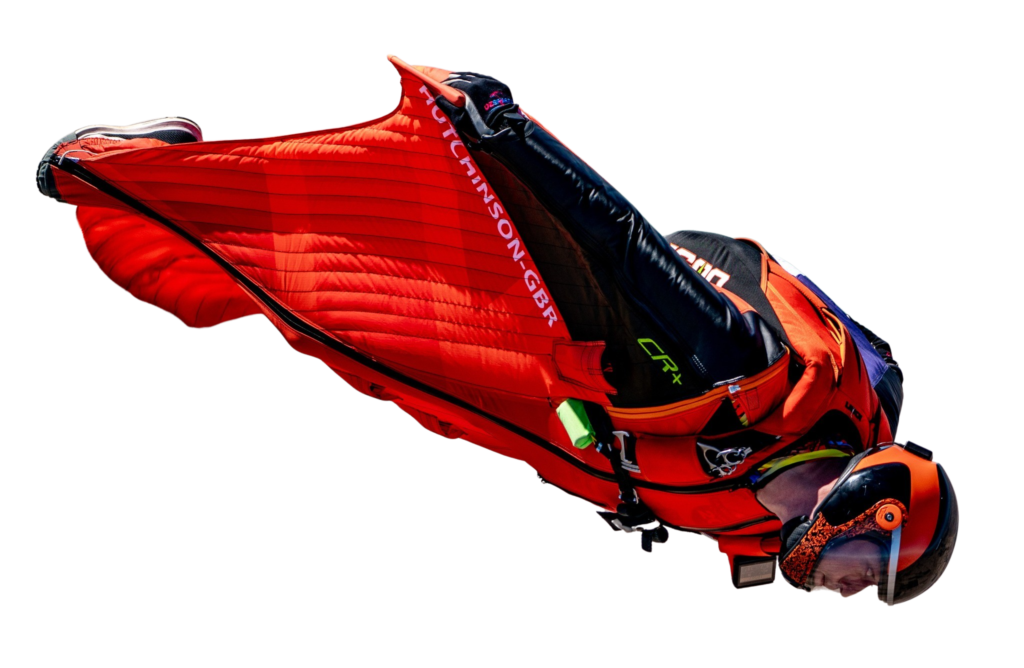
The competition format
- Rounds: three rounds of all three tasks, so nine flights in total. The order of tasks is drawn at random at the competitor briefing.
- Exit altitude: between 10,500ft and 11,000ft as measured by the competition logging device. Exit above the maximum and the jump is invalid with a rejump granted.
- Competition window: 2,500m down to 1,500m above ground level. It never changes, even if the exit altitude is lowered for weather or airspace.
- Deployment: below the bottom of the window (1,500m AGL), at an altitude pre-set by the meet director.
- A valid competition needs at least one fully validated task.
How is it judged?
Scoring
For each task in each round, the top result scores 100 percent and every other competitor scores a percentage of it. Your percentages for a task are averaged across the rounds, and your three task scores are added together to give the final total. Separate classifications are ranked from the same jumps for Female competitors and Combined National Teams.
Lanes
Each pilot flies a designated lane 600m wide, centred on the line from their start position to an assigned ground reference point. Straying outside it costs a percentage of your result: 10 percent within 150m of the lane, 20 percent at 150 to 300m, and 50 percent beyond 300m, with a zero for repeat offences. Coming within 150m of another competitor in flight scores zero outright: the lanes exist to keep closing speeds of 200+ km/h apart.
Equipment
- Wingsuit: must match the manufacturer's design. Fit adjustments are allowed; aerodynamic modifications are not. Suits are inspected and marked by the judges before the competition and only marked suits may be jumped.
- Position logging: every run is measured by a Position Logging Device recording 3D position at 5Hz or better. At FAI events the organiser issues and mounts the PLD; at national events you typically fly your own GPS logger such as a FlySight.
- No ballast: competitors are weighed at the start and spot-checked during the competition; more than 2kg of variation triggers an inspection, and added or removed weight scores zero.
What are the categories?
At FAI first category events the field is ranked open, with separate classifications for Female competitors and for Combined National Teams scored from the same jumps. At national level, competitions are commonly split by suit size into three classes, with the advanced class the pathway to world-level competition:
- Rookie - small suits
- Intermediate - intermediate suits
- Advanced - advanced and large suits
Study the rules
The full rules, including lane penalties, equipment requirements and wingsuit measurement guidelines, are in the 2026 FAI/ISC Wingsuit Flying Competition Rules (PDF). Future editions are published by the FAI International Skydiving Commission.
Guides get you the framework. A coach gets you the reps. Find someone for where you are in your flying.
Frequently asked.
What is performance wingsuiting?
Performance wingsuiting is a competitive discipline measuring how fast, how far and how long a pilot can fly through a set altitude window. Pilots fly solo runs across three tasks: time, distance and speed.
What are the three performance tasks?
Time is the longest time spent in the competition window, in seconds. Distance is the furthest straight-line distance flown over the ground while in the window, in metres. Speed is that distance divided by the time, in km/h. A full competition is three rounds of all three tasks, nine flights in total.
Where is the performance judging window?
The competition window runs from 2,500m down to 1,500m above ground level. From exit to the top of the window the pilot chooses their approach, and generally more speed and dive into the window improves the result.
How is it scored?
In each round, the best result in a task scores 100 percent and everyone else scores a percentage of it. Your three percentages per task are averaged across the rounds, and your three task scores are added together for the final ranking.
What equipment do you need to compete?
A wingsuit that matches the manufacturer design (suits are inspected and marked by the judges), and a position logging device. At FAI events the organiser issues the PLD; at national events you typically fly your own GPS logger such as a FlySight. No added weight is allowed, and competitors are weighed with random checks.
What are the competition categories?
FAI first category events rank an open field plus separate Female and Combined National Team classifications. At national level, events are commonly split by suit size into Rookie, Intermediate and Advanced classes, with the advanced class the pathway to international competition.
Want this kind of thinking, monthly?
New episodes, field notes and event drops. One email a month. No marketing fluff, no hype.