

Introduction
Getting your WS1 proves you aren’t a hazard to yourself. Getting your WS2 proves you’re an asset to a formation. However, many students treat the WS2 as a “tick-box” exercise and fail because they haven’t consolidated the fundamentals. This guide breaks down why students struggle, how to avoid the “solo flight trap,” and the specific skills you should dial in before you start your WS2.
What WS1 Really Is
Now that you’ve qualified for your WS1 and have that sticker in your logbook, I can share a key insight: WS1 isn’t actually about your flying prowess. It is effectively a basic competency exercise focused on three core safety components:
- Safely exiting the aircraft (avoiding the tail).
- Deploying your parachute safely (cleanly and at the right altitude).
- Landing within a designated area.
If you can demonstrate those three things consistently—proving they weren’t just a fluke—congratulations, you get the grade! While this is a fantastic accomplishment that grants you access to the world of wingsuiting, the assessment actually says very little about the “flying” part of the flight.
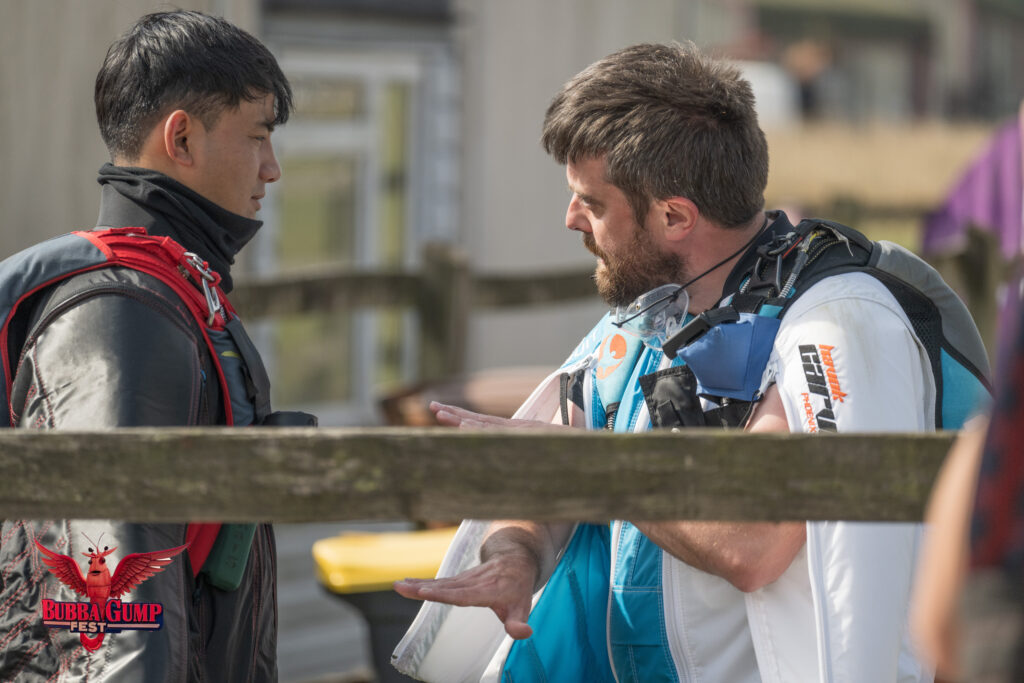
When you turn up for that assessment, our role as coaches is to:
- Provide high-quality ground school education.
- Offer real-time or post-jump corrections.
- Fly with you to document the jump for a proper debrief.
Chiefly, we make absolutely no assumptions that you have any prior wingsuit experience. We are there to build your foundation from zero. Holding a WS1 means you can finally fly with friends (up to 3-ways), but the lure of the “Big Way” event is strong. Everyone wants that WS2 sticker as soon as possible, but rushing into that progression is exactly where the problems start.
How WS2 Differs
There is a fundamental shift in expectations between WS1 and WS2. The most important difference is the assumption your coach is now making: that you have spent dedicated time consolidating your skills in smaller groups before showing up for the assessment.
We are now formalising those skills with a focus on three high-pressure areas:
- Relative Translation: Moving around your instructor (forward, backward, up, down, left, and right) while maintaining a safe distance.
- The “Dive to Pin”: Learning to close a gap safely, as you will likely be exiting last in larger groups.
- Recovery from Instability: Intentionally exiting unstable and returning to controlled flight—because in a large formation, you will get hit with wake turbulence at some point.
To assess these, the exit order flips. Unlike WS1, the coach now exits first. You must be able to fly to us, stay with us, and maneuver around us. This is the single biggest reason WS2 assessments fail: the student can fly a wingsuit, but they cannot yet fly with other people.
Why Students Fail WS2
Much of this really comes down to a number of core reasons:
- Rigid Body Position: The student is stable but simply cannot fly any faster or slower (vital for adjusting range or the “dive to pin”).
- Inability to Match Fall Rates: A student is either too floaty (cannot get down to the coach) or totally sinks out.
- Failing the Exit: This isn’t about safety; it’s about performance. If your exit clears the tail safely but you’re pointing in the wrong direction, you are already “behind the curve.”
- The 15m Gap: They can match an instructor’s speed but consistently trail 10–15m behind. We need to be able to see you to grade you!
How do students get here?
- The Solo Flight Trap: Doing your first 5–10 jumps solo is useful for confidence, but it allows bad habits (like poor body position) to become entrenched because you have no reference point for speed.
- Always the Base: Flying with friends is great for experience, but if you are always the “base,” you aren’t practicing how to fly to and around someone else.
- Lack of Variation: Constantly doing the same jump breeds familiarity, but it doesn’t exercise new skills or explore what your suit can really do.
Setting Ourselves Up for Success
Use this checklist to dial in your skills and turn that assessment into a “victory lap” rather than a struggle:
- Consolidate Your WS1: Don’t rush. Build genuine autonomy. Dress your own kit, plan your own flight path, and execute it flawlessly. Prove to yourself that you “have this.”
- Don’t Just Fly with Friends; Fly With Them: Avoid the “lazy flock.” Rotate the formation, practice chasing, and try flying on different sides.
- Get “Funky” at Altitude: Challenge your stability. Try clapping your hands, kicking your legs, or touching your hips. This breaks up “frozen” body positions and proves that your core—not just your wings—is the engine of your flight.
- Seek Professional Coaching Early: The UK has world-class British Skydiving coaches. Grab one to learn how to “climb like a homesick angel” or how to put on the brakes without losing stability.
- Explore Performance Profiles: Learn how to fly fast for speed, slow for time, and flat for distance. These skills are the “gears” you need for flocking.
WS2 and the Indoor Tunnel
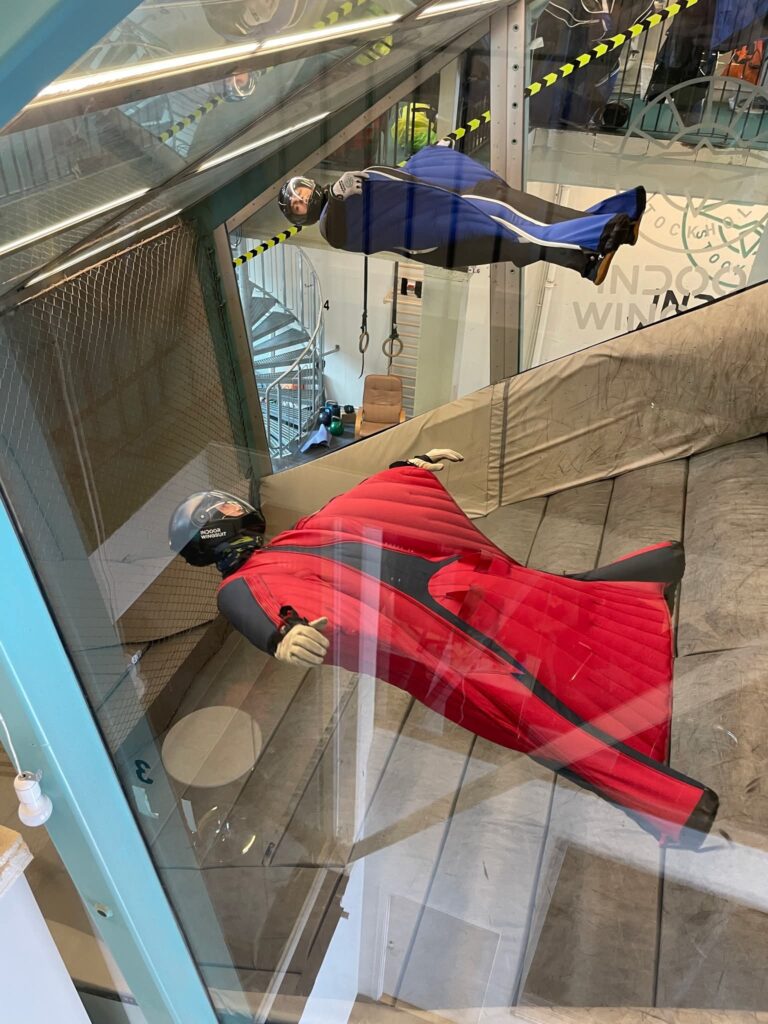
The Indoor Wingsuit tunnel is an exceptional tool to prepare for WS2. We can teach almost all the skills (except the physical dive to pin and aircraft exit) in a safe, consistent environment. This includes:
- Fixing body positions.
- Learning to fly a variety of speed profiles.
- Adjusting glide ratios for those who sink or float.
- All the basic manoeuvres needed for the assessment.
Conclusions
The jump from WS1 to WS2 is arguably the most significant transition in a wingsuiter’s progression. It represents the shift from being a “passenger” in a nylon suit to being a pilot capable of complex, relative flight.
Remember, the goal isn’t just to get the sticker; it’s to be the person everyone wants to fly with at those big-way events. By consolidating your basics, embracing the “funky” side of flight, and utilizing tools like the tunnel, you aren’t just preparing for an assessment—you’re building a foundation for a long, safe, and exhilarating wingsuiting career.
Don’t rush the process. Enjoy the journey of learning your suit’s limits. When you finally turn up for that WS2 assessment and find yourself effortlessly “on the wing” of your coach, you’ll realize that the extra preparation wasn’t just about passing a test—it was about truly learning to fly.
Blue Skies, and see you on the flight line!
About the Author
Passionate thick-cloud-hater Chris Judd (the wingsuit one) has been skydiving since 2006 and flying wingsuits since 2011. A resident Phoenix-Fly fanboy, he’s a British Skydive Wingsuit Coach, winner of the 2023 Intermediate Performance Nationals and, in conjunction with the Indoor Wingsuit Tunnel in Stockholm, runs indoor camps for UK wingsuit pilots several times per year. To contact him, reach out through the UK Wingsuiting website.